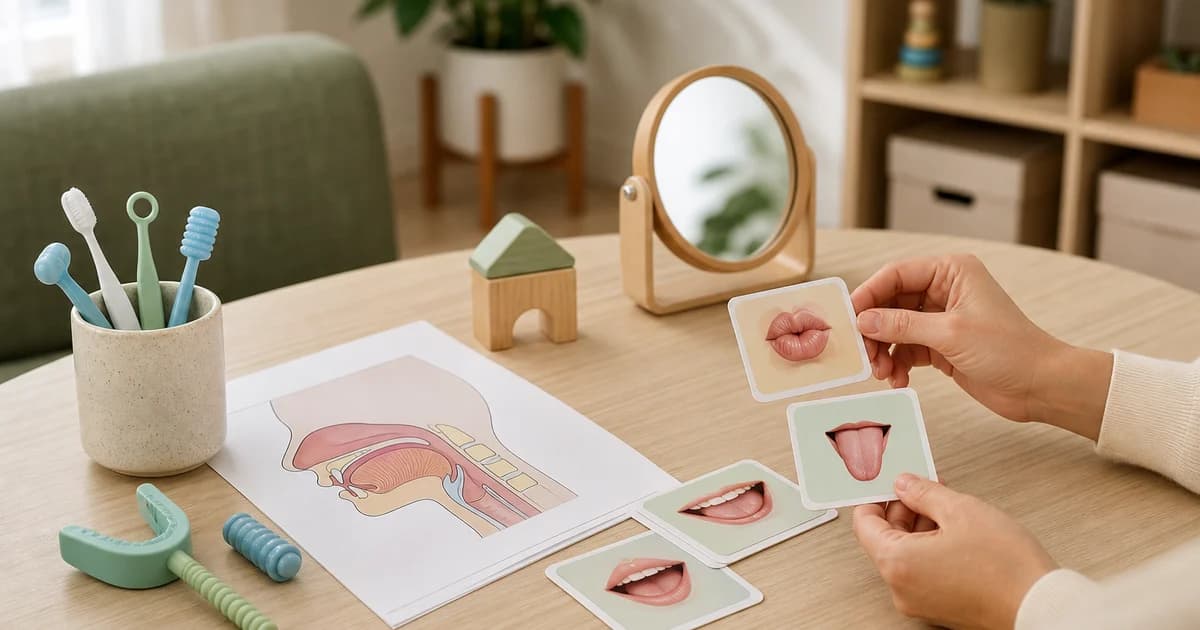
GOPEX therapy is a structured plan for working on orofacial functions: nasal breathing, resting tongue posture, swallowing and chewing. It is worth considering when a child or teenager has established functional difficulties, and a specialist confirms that the nose is clear or that proper ENT, allergy, or orthodontic care is running alongside it.
What is GOPEX therapy and how does it differ from ordinary exercises?
GOPEX is a structured way of working on the functions of the mouth and face. It is not just one exercise, or reminding a child to "close their mouth". The therapist first assesses the breathing pathway, tongue position, lip function, chewing, swallowing, muscle tension and bite conditions, and only then selects an exercise plan.
In practice, the parent receives specific tasks for home and a way of observing change. This matters, because orofacial functions become established in everyday life: during sleep, eating, resting, speaking and play. The clinic room alone is not enough if the child returns to earlier habits for the rest of the day.
If you are looking for a broader introduction to working on the tongue, lips and bite, our guide to MFS stimulators in myofunctional therapy may also help. GOPEX and MFS are not the same thing, but both topics belong to the field of working on function, not just on a single sound.
When should GOPEX be considered for a child?
A consultation towards GOPEX makes sense when a child often breathes through the mouth despite there being no acute infection, sleeps with an open mouth, has difficulty closing the lips, or the tongue rests low and pushes between the teeth. Tongue-thrust swallowing, difficulty biting firmer food, interdental lisping, or a malocclusion often appear alongside these.
Not every one of these symptoms means a child needs GOPEX specifically. Sometimes the first step is classic myofunctional therapy, an ENT consultation, allergy treatment, or an orthodontic assessment. Our article on when a mouth-breathing child should see a speech therapist describes the red flags and the safe order of steps in more depth.
GOPEX most often fits situations where the family is ready for regular home practice and the child is able to cooperate with the therapist. The method requires repetition, patience and observation, so it is not a good choice as a "quick fix" before an important appointment or braces.
Important
When is an ENT specialist, allergist, or orthodontist needed first?
If the nose is not clear, the child snores, or has pauses in breathing during sleep, the priority is airway safety. In that situation a speech therapist can describe the functions and note what they observe, but diagnosing the cause is a doctor's job. The same applies to suspected allergy, enlarged tonsils, or other anatomical obstructions.
An orthodontist is needed when there is a visible open bite, significant dental arch narrowing, an overbite, an underbite, or when a child is about to start treatment with braces. This collaboration matters because the tongue, lips and jaw affect the stability of function, and bite conditions affect how exercises can be safely carried out. We write about similar coordination in our article on how a speech therapist and orthodontist work together with a child wearing braces.
A good plan does not choose one specialist "instead of" another. Most often it clarifies roles: the doctor checks airway patency and safety, the orthodontist checks bite conditions, and the speech therapist or neurologopedist works on the functions of breathing, swallowing, chewing and articulation.
What does the assessment for GOPEX therapy look like?
The first consultation starts with a case history. The therapist asks about sleep, breathing during the day and night, infections, allergies, feeding, food selectivity, oral habits, orthodontic treatment history, and any recommendations received so far. It is worth bringing documentation from an ENT specialist, allergist, or orthodontist if it exists.
The specialist then assesses the resting position of the tongue and lips, the way saliva and food are swallowed, tongue mobility, cheek tension, jaw function, and articulation. In some children they also check tolerance to stimuli inside the mouth, because oversensitivity can make systematic exercises harder.
After the assessment, the parent should understand three things: what the main goal of the work is, which symptoms need a parallel medical consultation, and what the day-to-day plan will look like. If these points are not clear, it is better to ask before starting the programme.
It is also worth asking about review criteria. Good criteria are specific: does the child rest with closed lips more often, can they find the tongue position on the palate, do the exercises avoid increasing tension, and do eating and sleep raise no new concerning observations. Such a conversation helps distinguish real functional change from a simply "nicely performed" exercise in the clinic room, and makes it easier to plan the next review calmly and talk with the other specialists caring for the child.
What GOPEX works on: breathing, swallowing, chewing and the tongue
The most common goal is building more stable nasal breathing when medical conditions allow it. The therapist does not "treat the nose", but helps the child recognise the correct resting position, close the lips without excessive tension, and establish tongue function on the palate.
The second area is swallowing. In an abnormal pattern, the tongue may push against the teeth or rest between them. This pattern is sometimes linked to interdental lisping and an open bite, so the work plan often includes both swallowing exercises and articulation. If the main problem is pronunciation, also read our article on the causes of lisping in children.
The third area is chewing. A child may prefer soft food, chew on one side only, or swallow food that has not been broken down properly. Exercises are not meant to force eating "by pressure". Their goal is to gradually support coordination, sensation and muscle function in real, safe situations.
It is also worth remembering that breathing, swallowing and chewing reinforce each other. A child who consistently holds the tongue low may position the jaw differently during rest and eating. A child who does not feel a stable tongue position may tire more quickly during articulation exercises. This is why a GOPEX plan should not pick one symptom in isolation, but should organise several everyday functions in a logical order.
What does home practice and contact with the therapist look like?
At StacjaMowa, the GOPEX package includes an hour-long diagnostic session and 30 days of contact with the therapist. This time is used not only to hand over exercises, but also to refine the plan, discuss difficulties, and check whether the tasks are workable within the family's daily rhythm.
The parent may receive short instructions, photos, or a description of exercises, depending on the child's needs and the agreed form of work. What matters most is that the exercises are performed calmly, regularly and without pressure. In function-based therapy, the quality of repetitions usually matters more than long, tiring sessions.
If an exercise causes pain, an intensified gag reflex, strong resistance, or worsened breathing, it is not worth "pushing through" the plan. Such signals need to be discussed with the therapist and, if necessary, coordinated with another specialist.
For many families, the hardest part is not the exercise itself, but fitting it into the day without conflict. A short ritual tends to work well: the same time, a clear start and end, simple feedback, and no comparing the child to siblings or peers. If the plan requires constant persuasion, the task usually needs to be simplified or the order of work changed.
Tip for parents
What does GOPEX therapy not promise?
GOPEX therapy does not guarantee that a child will stop breathing through the mouth within a set time. It does not replace allergy treatment, ENT procedures, sleep apnoea diagnostics, or braces if these are needed. Nor should it be run as a stand-alone response to snoring or suspected sleep problems.
A safe expectation sounds different: GOPEX can help organise daily work on function, increase awareness of the tongue and lips, and support cooperation between the family, the speech therapist and the orthodontist. The outcome depends on the cause of the difficulty, the child's age, whether the nose is clear, the regularity of exercises, and treatment carried out by other specialists.
Caution is especially important with content found online. A video of an exercise may look simple, but without an assessment there is no way to know whether the child has adequate tongue mobility, stable nasal breathing, suitable bite conditions and sensory readiness. Choosing tasks independently can be misleading, because the same symptom can have different causes.
GOPEX therapy at StacjaMowa in Gdańsk
At StacjaMowa, GOPEX is treated as part of working on function, not as a separate promise of a quick effect. During the visit we look at breathing, swallowing, chewing, tongue position, articulation and treatment history. If an ENT, allergy, or orthodontic consultation is needed, the parent receives clear information that functional therapy should run alongside that stage.
This model helps parents avoid a chaos of recommendations. Instead of separate, random exercises, the child gets a plan with priorities: what matters most right now, what to observe at home, when to come back with feedback, and which decisions should stay with the doctor or orthodontist. This way, speech therapy, myofunctional therapy and orthodontic support can complement each other.
You can start with the GOPEX therapy in Gdańsk service page, which describes the scope of the package. If you are not sure whether to choose GOPEX, myofunctional therapy, or a speech therapy consultation, get in touch with us through the contact form.
Key takeaways
In short
- GOPEX addresses orofacial functions: breathing, swallowing, chewing, tongue position and lip function.
- With snoring, breathing pauses, or chronic nasal blockage, medical assessment is needed first.
- The programme makes sense when the family can regularly follow the recommendations and discuss difficulties with the therapist.
- GOPEX therapy can support orthodontic treatment, but it does not replace the orthodontist's decisions.
- The safest plan combines an assessment of function, realistic goals and cooperation between several specialists.
Sources and further reading
The materials below are educational context. They do not replace an individual assessment of your child or a personal therapy plan.
- ASHA: Orofacial Myofunctional Disorders
- AAPD: Policy on Obstructive Sleep Apnea
- Camacho et al. 2015: Myofunctional Therapy Treat Obstructive Sleep Apnea
- Bandyopadhyay et al. 2020: Effect myofunctional therapy on children with obstructive sleep apnea
How to book a GOPEX consultation?
If you notice mouth breathing, difficulty swallowing, an abnormal tongue position, or a question from an orthodontist about orofacial functions in your child, a consultation can help organise the next steps. In Gdańsk you can book a visit at StacjaMowa and discuss whether GOPEX is the right choice or whether it is better to start with a different type of support.
Want to learn more about therapy options?
Learn more about this therapyFrequently asked questions
- Is GOPEX therapy for every mouth-breathing child?
- No. First, the cause of mouth breathing needs to be checked and it must be confirmed that the child can safely breathe through the nose. GOPEX can be considered when there are functional indications and the family is ready for regular home practice.
- Does GOPEX replace a visit to an ENT specialist?
- No, it does not. Snoring, suspected breathing pauses, chronic nasal discharge, allergy, or nasal blockage require medical assessment. A speech therapist can describe the functions and point out the need for a consultation, but does not diagnose nose or sleep conditions.
- How is GOPEX different from myofunctional therapy?
- GOPEX is a structured programme for working on orofacial functions such as breathing, swallowing, chewing and tongue position. Myofunctional therapy is a broader area of speech therapy work. In practice, the decision depends on the diagnosis and the goal of therapy.
- Does GOPEX help with braces?
- It can support work on functions that matter for orthodontic treatment, but it does not replace the orthodontist's decisions. With a malocclusion, the plan should be coordinated with orthodontic treatment and adapted to the child's age and abilities.
- How long does GOPEX therapy take?
- At StacjaMowa, the GOPEX package includes an hour-long diagnostic session and 30 days of contact with the therapist. The further plan depends on symptoms, cooperation at home, and recommendations from other specialists. It should not be treated as a guarantee of a result within a set time.
- How should I prepare for the first GOPEX consultation?
- Note when the child breathes through the mouth, whether they snore, how they sleep, how they eat, and whether they have difficulty swallowing. Bring recommendations from an ENT specialist, allergist, or orthodontist if any were issued. Calm observations from home are also helpful, but they do not replace an assessment.