Many adults find lisping in pre-schoolers endearing, treating it as a natural stage of speech development that will “pass on its own.” Articulation does keep developing until around the sixth year of life, yet some forms of lisping - especially those where the child pushes the tongue between the teeth - never disappear without a therapist's intervention.
What exactly is lisping (sigmatism)?
Lisping, medically called sigmatism, is the incorrect pronunciation of the so-called dental sounds. This mainly concerns three groups of sounds that appear in a child's development at different times:
- the sibilant group (s, z, c, dz),
- the hushing group (sz, ż, cz, dż),
- the hissing group (ś, ź, ć, dź).
If a five-year-old says “safa” instead of “szafa” (wardrobe), this is often simply a delay in natural development (so-called physiological lisping), because the hushing sounds appear latest. If, however, the child pushes their tongue between their teeth while saying “słońce” (sun) - this is a speech disorder (interdental lisping) that requires work straight away, regardless of the child's age.
Physiological or pathological?
The most common causes of lisping in children
A speech disorder almost never appears “out of nowhere.” It is a symptom of an abnormality in the anatomy or functioning of the speech organs. The most common causes of sigmatism include:
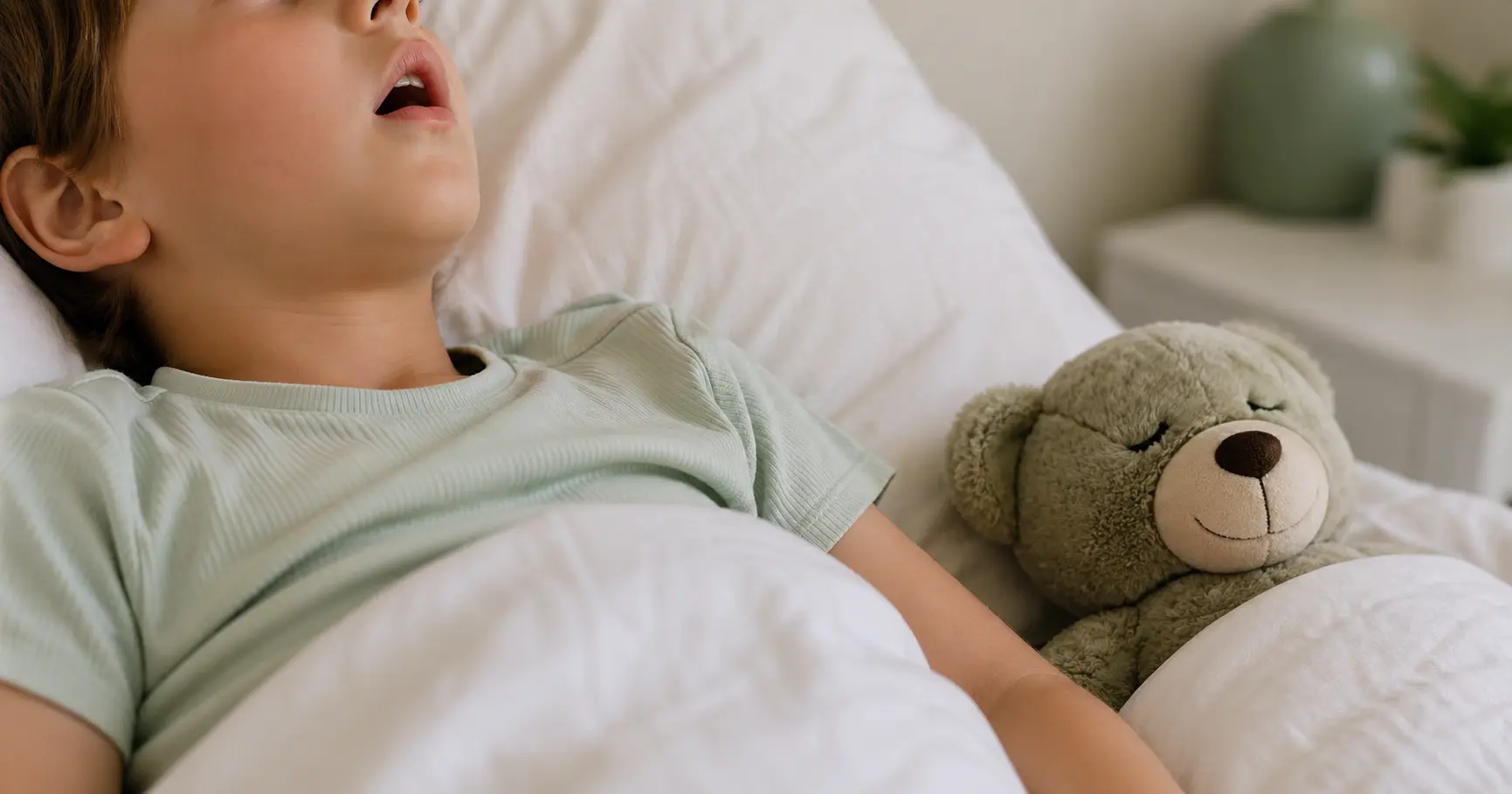
Mouth breathing. A constantly open mouth lowers the muscle tone of the lips and cheeks. The tongue rests on the floor of the mouth and becomes floppy, which is a direct route to it slipping between the teeth during speech. We write about when an open mouth needs a wider consultation in our article on a child breathing through the mouth.
A shortened lingual frenulum (ankyloglossia). If the tissue under the tongue is too short, the tongue has no physical way of lifting to the palate to correctly pronounce sounds such as “sz.”
Prolonged dummy or thumb sucking. These habits entrench an infantile swallowing pattern and distort the palate and the bite.
Malocclusion. An open bite (a gap between the teeth) creates an ideal space for the tongue to slip into.
When should you take your child to a speech therapist?
A quick diagnosis can spare a child difficulties at school - remember that children with speech disorders also frequently struggle with learning to read and write (risk of dyslexia). If you notice signs of delayed speech development in your child, it is worth consulting a specialist as early as possible.
A visit to a children's speech therapist is strongly recommended if:
- the child (even a two-year-old!) pushes the tongue between the teeth or lips while speaking or at rest,
- after age 3 the child's speech is completely unintelligible to those around them,
- facial asymmetry is visible while speaking (so-called lateral lisping, which distorts the airflow),
- at 5-6 years old the child still does not pronounce the hushing sounds (sz, ż, cz, dż).
It is worth remembering that lisping is often not only an articulation problem but also an orofacial function problem. That is why at StacjaMowa we often combine speech therapy with myofunctional therapy, to strengthen at the same time the muscles responsible for correct tongue position, breathing, and swallowing.
A tip for parents
Proven speech therapy exercises for home practice
Speech therapy is teamwork - with the speech therapist in the clinic and the parent at home. Below are exercises that prepare the articulation apparatus (so-called mouth and tongue gymnastics), which are worth weaving into everyday routines:
- “Horse” (tongue clicking): a great exercise that lifts the tongue, helping to strengthen the muscles used for pronouncing the hushing sounds and “r.”
- “Painting the ceiling”: the child opens their mouth wide and moves the tip of the tongue from the teeth towards the back of the palate (“painting the ceiling”).
- “Licking jam”: spread jam or chocolate spread on the child's upper lip, and their task is to lick it off with the tip of the tongue while keeping the mouth open. This strengthens tongue elevation.
- Drinking through a curly straw: strongly engages the orbicular lip muscle, helping the lips close correctly.
If your child has been started on ENMOT electrostimulation, make sure to strictly follow the recommendations the therapist adds to the home exercises.
Key takeaways
- A child will not simply grow out of interdental or lateral lisping - speech therapy support is required.
- The main causes of speech disorders are shortened frenula, poor habits (dummy use), and mouth breathing.
- Before working on eliciting sounds, it is essential to improve the articulation organs both at home and in the clinic.
- It is worth having speech development checked before starting school, to minimise the risk of educational difficulties.
Sources and literature
- Jastrzębowska G., Pelc-Pękala O., “Logopedia. Pytania i odpowiedzi” [Speech Therapy. Questions and Answers], Wydawnictwo UO.
- Skorek E.M., “Oblicza wad wymowy” [The Faces of Speech Disorders], Wydawnictwo Akademickie Żak.
- Position of the Polish Speech Therapy Association (PTL) on speech therapy prevention at pre-school age.
We describe the scope of speech therapy support on our speech therapy in Gdańsk page.
Want to learn more about therapy options?
Learn more about this therapyFrequently asked questions
- Should a four-year-old already be able to say "R"?
- No, the "R" sound is one of the most difficult to articulate and is entitled to appear naturally as late as between the ages of 5 and 6.
- My daughter says "safa" instead of "szafa" (wardrobe) - is this a reason to worry?
- If your daughter is 3-4 years old, this is a natural developmental process (substituting hushing sounds with sibilant ones). If, however, she is over 5 or pushes her tongue between her teeth while speaking, you should seek a diagnosis.
- Which dummies are safest for the bite and for speech?
- Always the smallest and most symmetrical ones, though even an "orthodontic" dummy used excessively past age 1 can negatively affect the resting position of the tongue.
- How often should I practise with my child at home?
- We recommend "micro-sessions" - it is better to practise 3 times a day for 3-5 minutes, for example before brushing teeth, than once a week for half an hour.
- Can a child grow out of interdental lisping?
- No. Interdental lisping (the tongue pushed between the teeth) is a disorder that does not resolve on its own. The earlier therapy begins, the faster and more lasting the results.
- Does myofunctional therapy help with lisping?
- Yes, in many cases lisping results from abnormal orofacial functions (mouth breathing, infantile swallowing). Myofunctional therapy prepares the muscular groundwork, which makes classic articulation correction more effective.