When a relative develops dementia, conversation changes gradually: they lose words, repeat the same questions, and stop following longer utterances. Your behaviour in conversation genuinely matters - in dementia the carer's approach is the intervention, and a speech therapist teaches you how to talk so that contact succeeds.
How does dementia change conversation?
Early changes can be subtle. A relative searches for words longer, returns to the same story, or gets lost in longer conversation, especially with background noise or in a larger group. Over time it becomes harder to follow the thread, understand complex sentences and answer accurately - thinking slows, concentration fades, and a sentence may break off halfway. In the later period speech may shrink to single words, and gesture, facial expression and touch become the main channel of contact.
Every person travels this road differently. Signs depend on the type and stage of dementia, and they vary from day to day - worse with tiredness, pain, infection or evening confusion. A single sign says nothing about which stage you are dealing with or what comes next, so always leave assessment of changes to the physician and the specialist who sees your relative in person.
How is dementia different from aphasia after stroke?
After stroke communication collapses suddenly and then - with good rehabilitation - often partly returns. All effort goes into the patient: exercises, training, regaining function. That is why articles about post-stroke rehabilitation, such as our text on aphasia after stroke and its therapy, assume improvement - rightly so, because there improvement is a realistic goal.
In dementia the situation is reversed. Difficulty builds gradually, driven by memory and attention rather than a damaged language system, and there is no point after which function returns. Strategies aimed at recovery - repeated drills, memory quizzing, correcting mistakes - can mislead here and end in frustration on both sides. Unclear speech caused by the muscles is a different matter: we write about it in the article on dysarthria and speech therapy, where the person knows what they want to say but the body cannot keep up. In dementia it is the content of conversation that falls apart first.
Diagnosis belongs to the physician
Indirect therapy - your role in the treatment
In dementia the therapy room looks different than after stroke. The patient receives no exercise set for regaining speech, because there is nothing to regain. Instead the speech therapist works with you: observing your conversation, showing what blocks it, and arranging a plan of small changes in your behaviour. This is called indirect therapy - you are its main performer, and the specialist is your coach.
Research on such carer coaching shows that afterwards carers manage conversation better and reach for proven strategies more often, and they describe the strategies as helpful and easy to weave into daily life. Therapy does not stop the disease or restore lost function - its goal is successful contact and fewer crises at home.
What can you change tomorrow?
The principles below follow directly from how dementia works: since memory fails, do not build conversation on it, and since attention is fragile, protect it from everything that distracts.
- Start with attention. Say your relative's name, stand face to face, wait for eye contact. Only then speak.
- Quiet the background. Turn down the television and radio, talk in calm surroundings. One idea at a time, short sentences, a slower pace and long pauses for the answer.
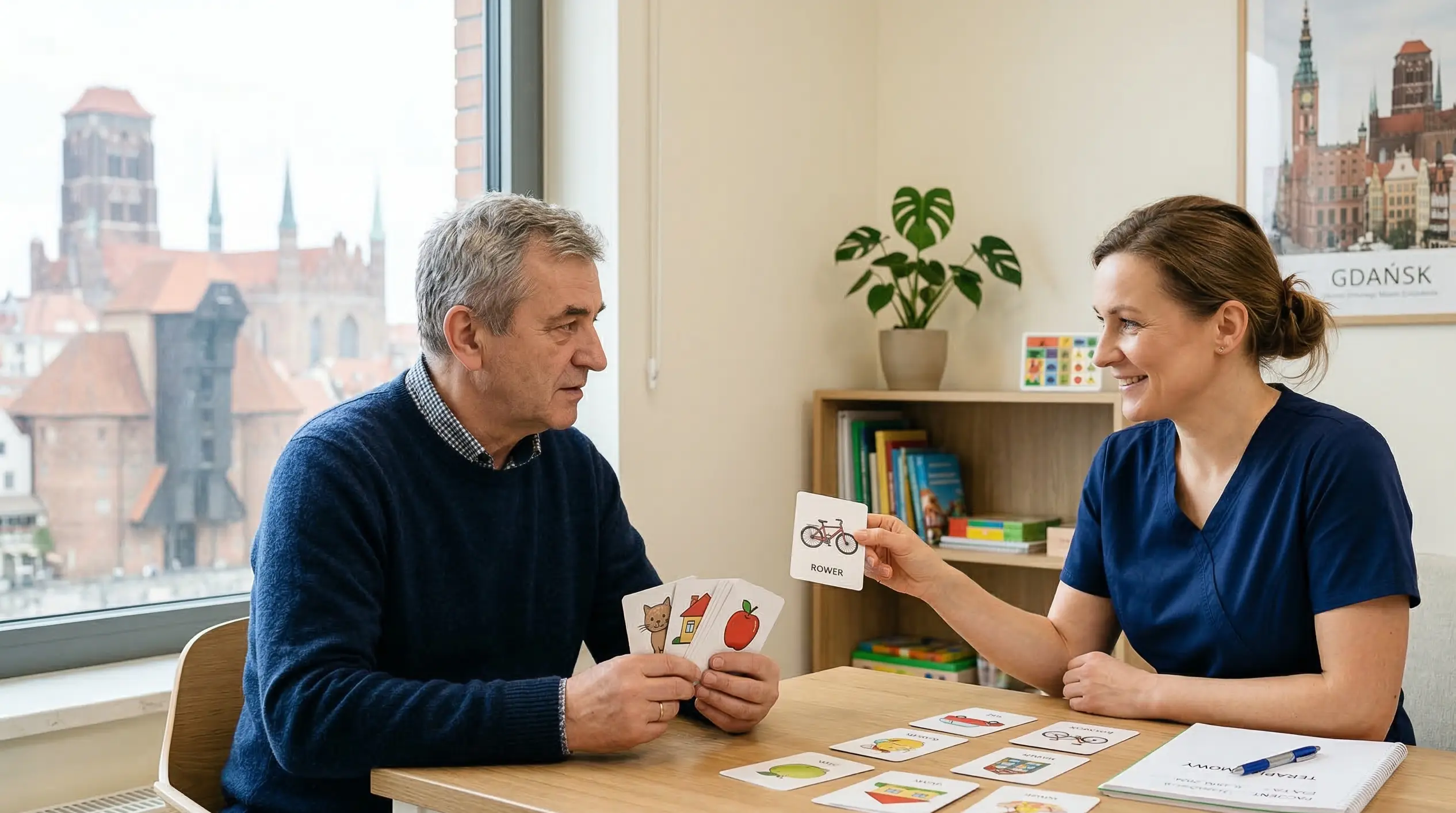
- Offer a choice instead of an open question. Rather than “What would you like?” ask “Tea or coffee?”. Too many options at once overwhelm just as much as no question at all.
- Do not quiz memory. Questions such as “Do you remember who called yesterday?” embarrass and frustrate. It works better to talk about what you remember and give time for free recall.
- Do not argue about false beliefs. When they cause no harm and do not distress the person, there is no need to correct them. Acknowledge the feeling behind them and gently redirect the conversation.
- Answer the feeling, not only the words. When your relative is upset, first show that you see it - only then look for a solution.
- Include your relative in conversations with others. Do not talk about them as if they were absent - being passed over takes away self-worth faster than any missing word.
- Lean on what can be seen and touched. Photos, objects and written cards help when words fall short. Plan important conversations for a good time of day, not the evening, when concentration usually drops.
A choice instead of a question
When conversation falls apart
Repeating the same question can signal worry, not defiance. A calm, short answer every time works better than irritation - and when questions return in waves, look for an unmet need: hunger, pain, tiredness, boredom. Evening confusion and restlessness have their own rhythm too, so save difficult topics for the morning.
You have the right to a break. When you feel your voice rising or your patience thinning, step away for a moment if it is safe and come back once you have calmed down. Humour releases tension as long as you laugh together - never at your relative. And when confusion suddenly and clearly worsens, report it to the physician: sometimes infection, dehydration or medication effects sit behind the decline, and those can be treated. More about everyday work with unclear neurological speech is in our article on dysarthria and family support.
Swallowing in advanced dementia - what to watch for?
In the later period of the disease, conversation stops being the only concern. Meals grow longer, food remains in the mouth, coughing during eating or a wet voice after swallowing appears. Weight loss, reduced drinking and recurrent chest infections are worrying too. No cough gives no certainty that swallowing is safe - some aspiration happens silently.
Do not change food textures on your own, thicken fluids, eliminate products or crush tablets. Such decisions affect hydration, nutrition and how medication works, so they need individual recommendations. A speech therapist performs an initial swallowing safety assessment and points to further medical diagnostics when needed. We describe the scope of such a consultation on the neurologopedic therapy page.
When is urgent help needed?
How can speech therapy support carers at StacjaMowa?
The first visit is diagnostic and planning-oriented. The specialist takes a history, observes your relative's communication in simple situations and your shared conversation, then discusses a plan with you: which strategies to introduce at home, how to respond in difficult moments, and what to watch for around mealtime safety. You receive concrete guidance for everyday life, not a promised outcome.
We also present the broader picture of work with adult neurological patients in our article on neurologopedic therapy and speech rehabilitation in neurological conditions. Details of the consultation and how to book are on the neurologopedic therapy page.
Key takeaways
- Dementia changes communication gradually and irreversibly - strategies aimed at regaining post-stroke function do not work in this situation.
- Indirect therapy works through your behaviour: the carer's approach is the intervention, and the speech therapist teaches how to lead it.
- Conversation is eased by: attention and calm, one idea at a time, a choice instead of an open question, and no memory quizzing.
- Do not forcefully correct false beliefs - acknowledge the feeling and gently redirect the conversation.
- Swallowing difficulty in the later period needs specialist assessment, never self-made changes to food and medication.
Sources and further reading
This article is educational. It does not replace medical diagnosis, speech and language therapy assessment or individual advice about communication, medication or swallowing.
- ASHA: Dementia - Practice Portal
- Folder et al.: Communication Partner Training for Families of People With Dementia (The Gerontologist)
- NHS: Communicating with someone with dementia
- Alzheimer's Society: How to communicate with a person with dementia
- Alzheimer's Society: Dementia and language
- Alzheimer's Association: Communication and Alzheimer's
- ASHA: Adult Dysphagia
Want to learn more about therapy options?
Learn more about this therapyFrequently asked questions
- How do I tell ordinary forgetfulness from dementia, and when should we see a physician?
- Ordinary forgetfulness does not break daily functioning, while dementia gradually makes it harder: losing the thread, repeating questions, struggling with simple decisions. Leave assessment to a physician - neurologist, psychiatrist or geriatrician - and go when changes build up or worry the family.
- Can memory exercises or cognitive training reverse conversation difficulty?
- No therapy reverses dementia, and memory quizzing usually ends in frustration on both sides. A speech therapist works differently: teaching the carer how to shape conversation so that contact succeeds despite the difficulty.
- My relative repeats the same question. Should I answer every time?
- Yes, calmly and briefly, every time. Repetition can signal worry or an unmet need, so look for its cause: hunger, pain, tiredness, boredom. Irritation and reproach do not reduce the number of repetitions.
- My relative states something untrue. Should I correct them or agree?
- Do not argue about beliefs that harm nobody and do not distress the person. Acknowledge the feeling behind them and gently redirect the conversation. When a false belief causes fear or leads to unsafe behaviour, discuss it with the physician.
- When should eating difficulty in a person with dementia worry a carer?
- See a specialist when meals clearly grow longer, food remains in the mouth, coughing during eating, a wet voice after swallowing, weight loss or recurrent chest infections appear. Do not change textures, fluids or medication on your own - that needs individual recommendations.
- What should I prepare for a first speech therapy consultation in dementia?
- Bring neurological records, the medication list and concrete examples from home: in which situations conversation succeeds, when your relative withdraws, what happens at mealtimes. Also note the times of day when contact is better and when it is clearly worse.