Aphasia is an acquired language disorder that can appear after a stroke. It may affect speaking, understanding speech, reading, or writing. Aphasia itself does not mean loss of intelligence, although other cognitive difficulties may also occur after stroke.
What is aphasia and why can it happen after stroke?
A stroke can interrupt blood flow to a specific area of the brain. When the injury affects language networks, most often in the left hemisphere, a person may suddenly struggle to find words, understand what others say, read, or write. This pattern is called aphasia.
Aphasia is not a psychiatric condition and it is not the same as dementia. A person with aphasia may understand their situation, feel emotions, remember loved ones, and have opinions, but lack reliable access to language. This distinction is important for families because it changes how they support communication.
Around one third of stroke survivors experience aphasia at least for some time. Its severity and presentation depend on the location and extent of the brain injury, so each person needs an individual assessment rather than a generic exercise plan.
Types of aphasia and how symptoms differ
Aphasia types help clinicians describe the main pattern of difficulty, but real-life symptoms often overlap. A person may not fit neatly into one subtype, and the picture can change during recovery.
Broca's aphasia usually affects spoken expression. Speech may be slow, effortful, shortened, and grammatically simplified. Understanding is often relatively stronger than speaking.
Wernicke's aphasia often causes fluent speech that is difficult to understand. The person may use unrelated words, create new words, and have marked difficulty understanding spoken language.
Anomic aphasia mainly affects word retrieval. A person may know what they want to say and describe an object, but struggle to retrieve its name.
Conduction aphasia is especially visible when repeating words or sentences. Understanding may be relatively preserved, while repetition is disproportionately difficult.
Global aphasia is a severe form in which both expression and comprehension are strongly affected. Some people may need communication support such as gestures, picture boards, or AAC.
For a broader view of communication and swallowing difficulties after stroke, see our guide to neurologopedic speech rehabilitation after stroke in Gdansk.
Aphasia and dysarthria: why the difference matters
Aphasia affects language: word finding, sentence building, understanding, reading, or writing. Dysarthria affects speech execution: breath support, voice, articulation, and muscle coordination. A person with dysarthria may know exactly what they want to say, but their speech may sound unclear, slow, quiet, or monotonous.
Aphasia and dysarthria can occur together after stroke. A neurologopedic assessment looks at both language and motor speech because each requires different therapy priorities and different family communication strategies.
Symptoms worth observing and describing to a specialist
Aphasia is not always complete loss of speech. Symptoms can be subtle, especially early after stroke when the person is tired or medically unstable. It is useful to observe:
- difficulty naming everyday objects, people, or places,
- using words that do not fit the context or creating new words,
- limited response to simple questions or instructions,
- speech reduced to a few repeated words or syllables,
- new difficulty reading messages, labels, or short texts,
- new difficulty writing a sentence or signing clearly,
- visible frustration during attempts to communicate.
Important
What happens during an aphasia assessment?
Assessment starts with a detailed interview with the patient or family. The specialist asks about the stroke, hospital treatment, discharge recommendations, and everyday communication since the event. It is also important to understand how the person communicated before the stroke: work, reading, writing, phone use, and languages used at home.
The clinician then checks spontaneous speech, naming, repetition, understanding words and sentences, reading, and writing. The goal is not just to label the type of aphasia, but to identify what helps communication, what blocks it, and what goals are realistic in the first stage of therapy.
The role of family in the first period after stroke
Family support is central, but relatives do not have to become therapists. The most helpful support is calm communication: short sentences, enough time to respond, avoiding interruption, not speaking over the person, and using gestures, drawings, or pointing when words are not available.
If swallowing difficulties are also present, the neurologopedic plan may include both communication and swallowing safety. We explain this in our article about dysphagia after stroke and neurologopedic support.
What can aphasia therapy include and how long does it take?
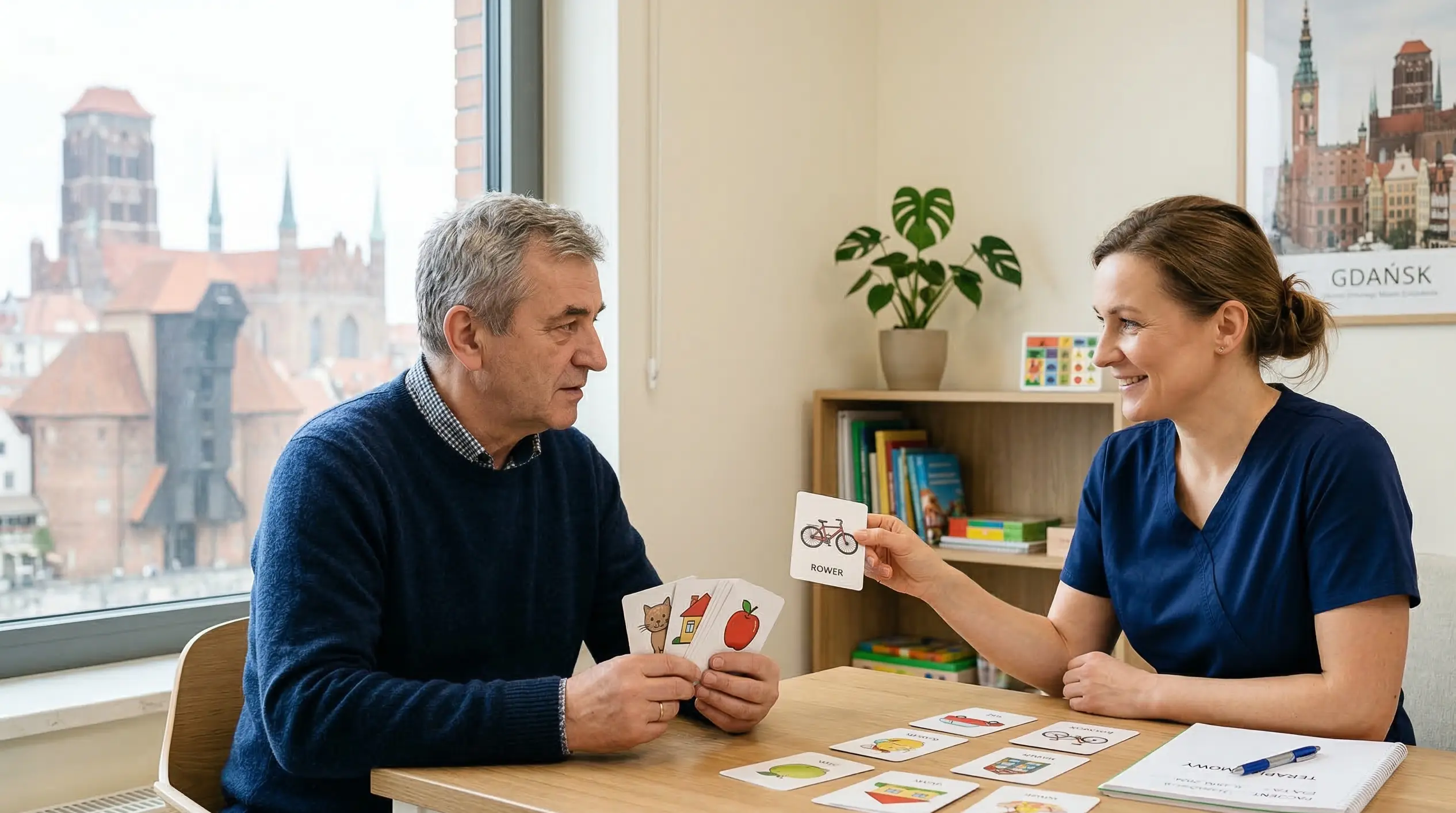
Aphasia therapy is not one fixed set of exercises. The plan depends on the type and severity of aphasia, the person's general health, preserved strengths, and daily communication needs. A neurologopedic therapist adapts methods to the individual, not just to the diagnostic label.
In practice, therapy may include:
- word finding, sentence building, comprehension, and repetition,
- reading and writing work when these functions are affected,
- communication practice in everyday situations,
- gestures, drawing, communication boards, or simple AAC tools,
- family education and communication-partner strategies.
The duration of therapy cannot be predicted precisely. European Stroke Organisation guidance recommends at least 20 hours of speech and language therapy for post-stroke aphasia. Many people need several months or longer, and some continue to improve communication skills in later stages after stroke.
When should therapy start? Can it be too early or too late?
Early assessment and therapy can support recovery when the patient is medically ready to work. It also helps the family understand the situation and avoid communication patterns that increase frustration.
Therapy can still be meaningful later. The goal is not always full return to pre-stroke speech, but more effective communication using the abilities and strategies available to the person now.
For families
When can AAC support aphasia therapy?
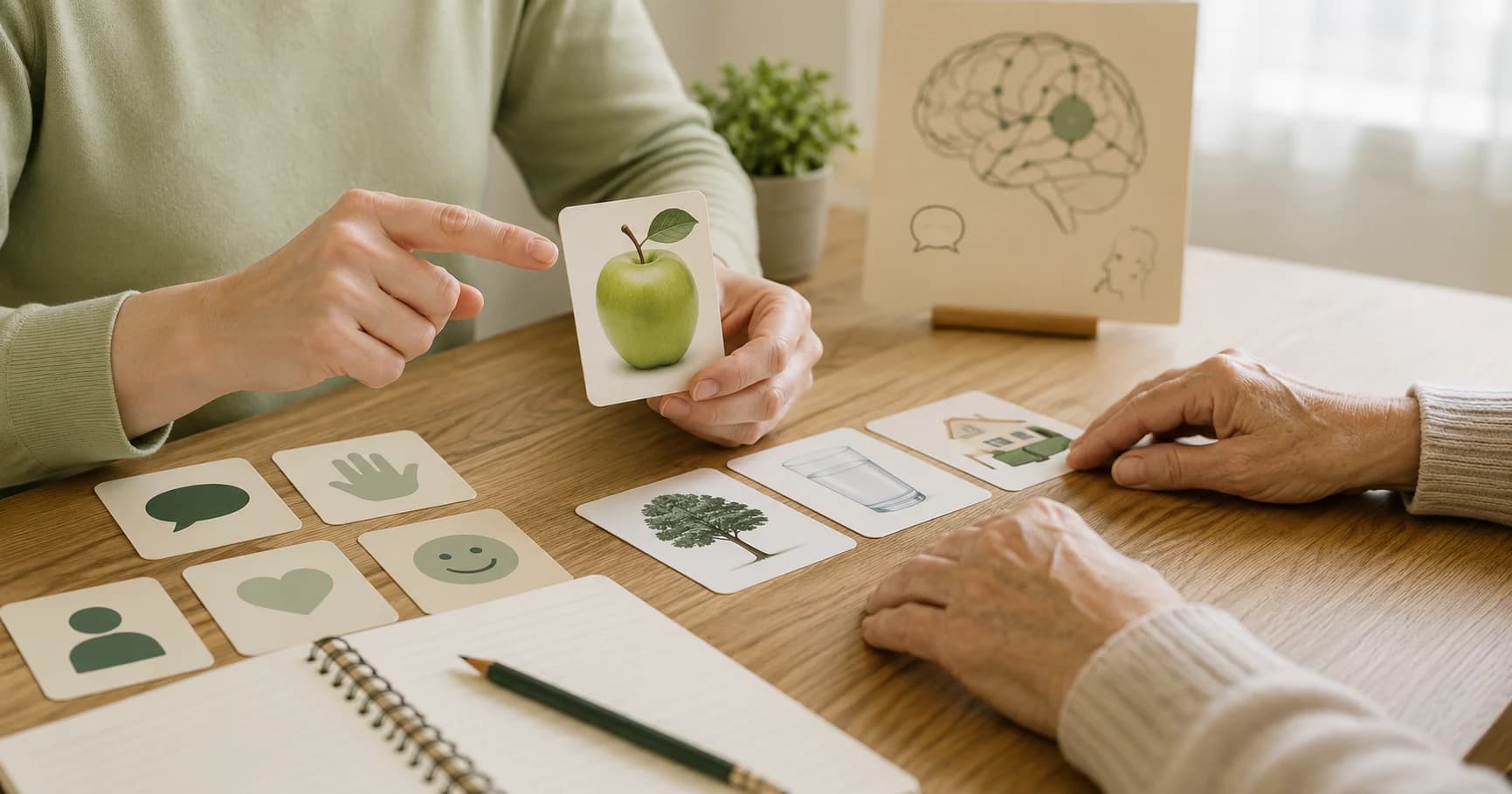
In more severe aphasia, spoken language may be very limited and the person may need other ways to communicate. Augmentative and alternative communication (AAC) can help express needs, answer questions, and take part in everyday life while verbal speech is limited.
AAC does not have to mean advanced technology. It can begin with picture boards, gestures, drawing, or pointing. The tool should match the person's current abilities and should be introduced with guidance. We describe general AAC principles in our article on introducing supported communication step by step.
Aphasia and other post-stroke difficulties
Aphasia is often not the only difficulty after stroke. Dysarthria, dysphagia, apraxia of speech, fatigue, and attention difficulties can overlap and affect everyday communication. A good plan looks at the whole clinical picture.
When difficulty builds gradually rather than appearing suddenly after stroke - words lost to memory, repeated questions, a fading thread - read our article on communicating in dementia and Alzheimer disease. Recovery-oriented post-stroke strategies may mislead in that situation.
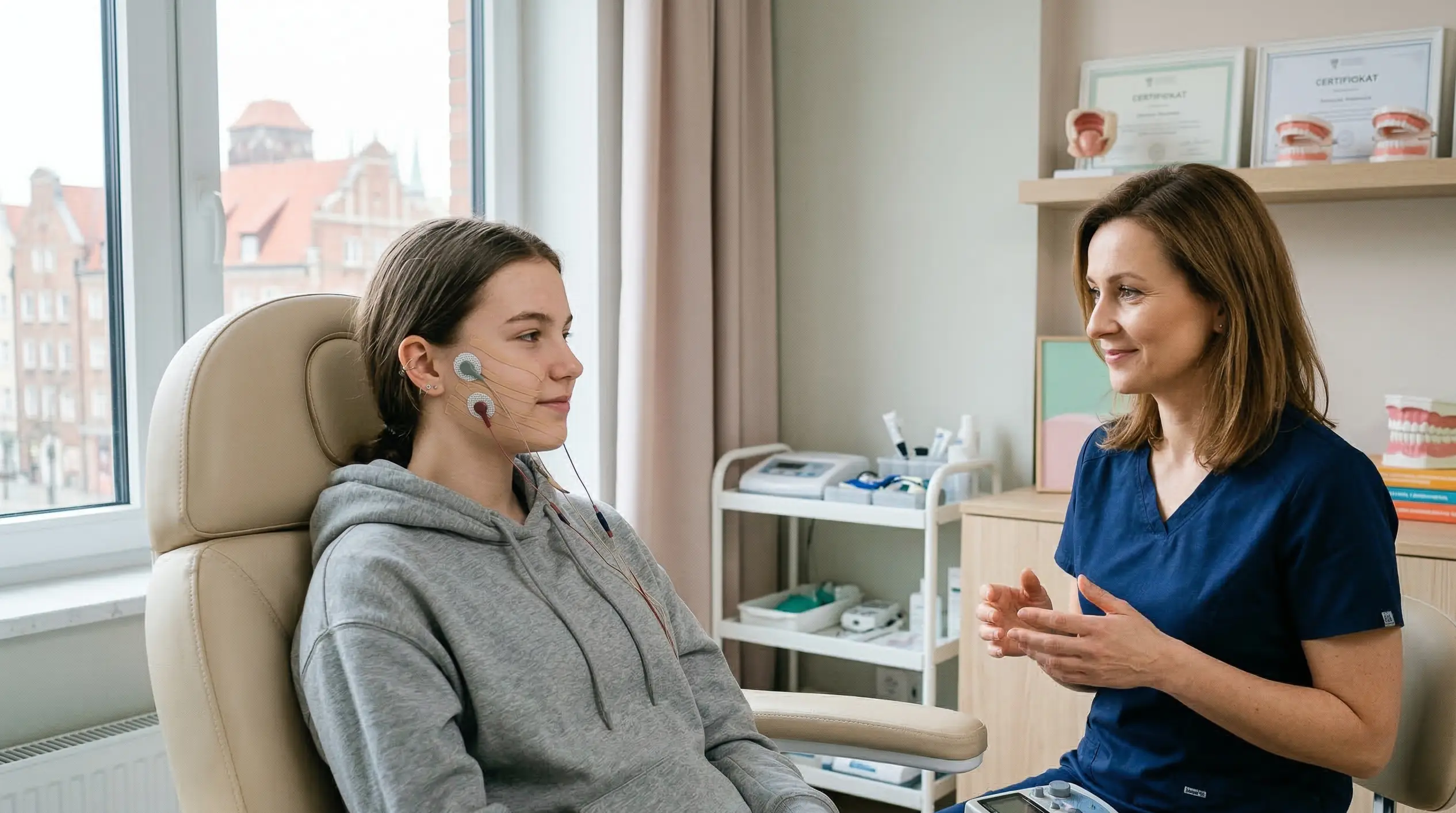
If aphasia co-occurs with dysarthria or swallowing difficulty, supporting methods for orofacial muscle work may be considered after qualification. They are not the core treatment for aphasia as a language disorder. We explain this broader context in the article about electrostimulation and taping in speech therapy.
Aphasia and neurologopedic therapy at StacjaMowa in Gdansk
At StacjaMowa, we assess aphasia in the context of the whole person: preserved language abilities, readiness for therapy, communication at home, and the goals that matter most to the patient and family. We begin with understanding the person, not with a generic worksheet.
You can read more about our scope of support on the neurologopedic therapy page. We do not promise full return to pre-stroke communication. The aim is to understand the difficulty, build practical ways to communicate, and set realistic next steps.
Key takeaways
- Aphasia is a language disorder, not loss of intelligence, although other post-stroke difficulties may co-occur.
- Different types of aphasia affect speaking, understanding, naming, reading, or writing in different ways.
- Early neurologopedic therapy can support recovery, but communication work may also help later after stroke.
- AAC can help people with severe aphasia communicate basic needs and participate in everyday life.
- Family support means calm, patient communication and following specialist guidance, not replacing therapy.
Sources and further reading
The materials below are educational. They do not replace individual medical, neurological, or speech-language assessment after stroke.
- Afazja. UAM Knowledge Portal: general information about aphasia (Polish)
- Neurologia po Dyplomie: Post-stroke aphasia (Polish)
- ASHA: Aphasia Practice Portal
- Brady et al. (2025). European Stroke Organisation guideline on aphasia rehabilitation
- NIDCD: Aphasia
- American Stroke Association: Aphasia Diagnosis and Treatment Options
- National Aphasia Association: What is Aphasia?
Want to learn more about therapy options?
Learn more about this therapyFrequently asked questions
- Can aphasia after stroke improve on its own?
- Some people improve in the first weeks and months after stroke because the brain partly recovers and reorganizes. The pace and extent of improvement are individual. Speech and language therapy can support this process and help the person use preserved language abilities.
- How long does aphasia therapy after stroke take?
- There is no single timeline. Duration depends on aphasia type and severity, lesion extent, age, health, and therapy regularity. European guidance recommends at least 20 hours of speech and language therapy for post-stroke aphasia, but many people need longer support.
- Does a person with aphasia understand what is being said?
- It depends on the type of aphasia. In Broca’s aphasia, understanding is often relatively stronger than speech production. In Wernicke’s aphasia, both understanding and meaningful speech may be affected. Each person needs individual assessment.
- How should I talk to a family member with aphasia?
- Use short, clear sentences, give time to respond, keep a natural tone, and support speech with gestures or pointing when helpful. Avoid speaking over the person or finishing every sentence for them. A therapist can show strategies matched to the person’s aphasia profile.
- Can children or young adults have aphasia after stroke?
- Yes. Aphasia can occur at any age if a stroke or another brain injury affects language networks. Stroke is more common in older adults, but younger people can also need aphasia assessment and therapy.
- Is aphasia therapy only clinic-based?
- No. Clinic sessions are important, but everyday communication at home also matters. The therapist can show family members how to support conversation and which activities can be practised between sessions.
- When should AAC be considered for aphasia?
- AAC can be considered when spoken language is very limited and basic communication is difficult. Simple picture boards, gestures, or pointing can be introduced early when appropriate. The tool should be selected after assessment of the person’s current abilities.