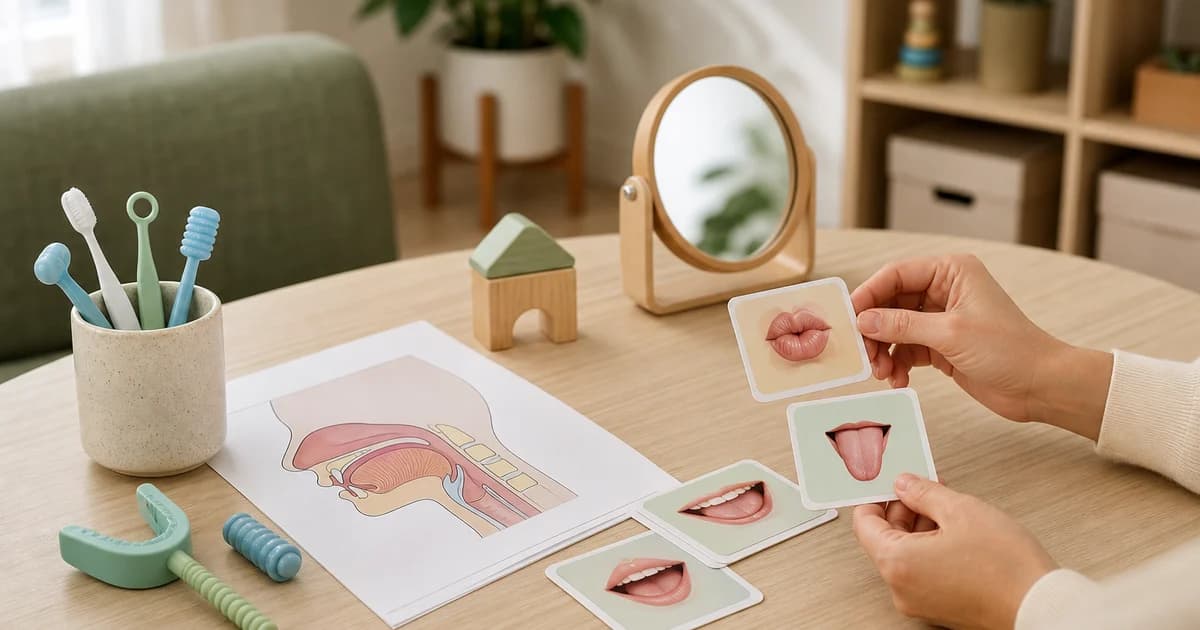
Chronic mouth breathing in a child can affect the bite, facial growth, and speech, because it changes tongue posture and the muscle balance around the mouth. That is why, in a child who constantly breathes through the mouth, it is worth assessing not only nasal patency but also tongue position, the bite, and orofacial function. This is where GOPEX therapy and MFS stimulators come in, delivered through collaboration between a speech therapist and an orthodontist.
Does mouth breathing affect the bite?
Occasional mouth breathing, for example during an infection or a heavy cold, is physiological and usually resolves once nasal patency improves. The problem begins when a child almost always keeps the lips apart, sleeps with an open mouth, snores, and is hard to encourage to breathe through the nose - this is when we speak of a fixed, abnormal breathing pattern.
With chronic mouth breathing, the tongue more often rests low, on the floor of the mouth, instead of against the palate. This tongue position changes the muscle balance between the cheeks, lips, and tongue, which in orthodontic literature is linked with a narrow maxilla, a high palate, crossbite, and a tendency toward Class II malocclusion. It does not mean that every mouth-breathing child will develop a bite problem, but a fixed oral pattern is one of the factors an orthodontist takes into account. If you are wondering where to start, we cover it in the article on when a mouth-breathing child should see a speech therapist and orthodontist.
Cause first
How does mouth breathing change facial growth?
A child’s facial skeleton grows under the influence of muscle forces and the way of breathing. Cephalometric studies in children with a history of mouth breathing describe a tendency toward a longer lower face and a larger mandibular plane angle compared with nasal breathers. The effect depends on the cause, how long the habit lasts, and the child’s age, so observing development over time matters more than a single measurement.
The practical takeaway for parents is calm: facial and bite development is a process shaped by many factors, and an early, structured assessment makes it possible to respond before patterns become fixed. The goal is not to alarm, but to support a healthy breathing pattern and muscle balance during the period when the facial skeleton is developing most intensively.
Mouth breathing, speech, and orofacial function
An abnormal breathing pattern affects not only the bite but also orofacial function: the resting posture of the tongue, lip seal, chewing, and swallowing. Children who breathe through the mouth more often present interdental lisping and difficulty articulating sounds that require good tongue and lip control. Less efficient breathing can also make it harder to repeat longer strings of words.
Chronic mouth breathing is sometimes linked with poorer sleep quality, and indirectly with attention, fatigue, and motivation to communicate. That is why, when assessing a child with delayed speech development, we look not only at vocabulary and sentence building but also at breathing, swallowing, and facial muscle work. We take the same cautious approach in the article on how myofunctional therapy for a mouth-breathing child works in practice.
What is GOPEX therapy?
GOPEX is a structured programme of breathing-postural exercises and muscle-balance work that supports a healthy breathing pattern and the coordinated work of the face, head, and neck muscles. It usually involves a dozen or so minutes of daily exercises, chosen individually and done under a trained therapist’s supervision. The exercises aim to restore nasal breathing and lip seal, stabilise tongue position against the palate, improve functional swallowing, and normalise muscle tone.
In a mouth-breathing child, GOPEX complements orthodontic and speech therapy rather than replacing them. It helps “reset” the muscular-functional system toward patterns that support healthy bite development and clear speech. We describe the indications and course in more detail in the guide to GOPEX therapy and restoring nasal breathing.
Quality over repetitions
How do MFS stimulators support orthodontic treatment?
MFS stimulators are flexible trainers that support learning correct tongue position, movement, and lip seal. They may be part of myofunctional therapy when a specialist sees specific indications and the child is ready to cooperate. Whether to introduce them depends on the assessment, the child’s age, bite conditions, and orthodontic or medical recommendations - they are not a universal solution for every mouth-breathing child.
In the context of orthodontic treatment, MFS may help reinforce functional patterns that work with the appliance, namely nasal breathing, lip seal, and correct tongue posture. They do not replace therapy or specialist supervision. We describe qualification rules and safe use in the guide to MFS stimulators, and the build and indications of the nose stimulator on its product page.
Why combine GOPEX and MFS with an orthodontist?
GOPEX and MFS stimulators work in the same area - breathing, swallowing, and tongue function - but in different ways. GOPEX organises the exercises and the everyday breathing-postural pattern, while MFS may support reinforcing selected tongue movements and lip seal. Combining the two makes sense only when it follows from the assessment, not from an assumption that “more is better”.
The best results come from specialist teamwork. The orthodontist assesses the bite and leads treatment with an appliance, the ENT doctor checks airway patency, and the speech therapist works on orofacial function. This coordination makes it possible to work on the cause of abnormal breathing, not only its effect, which improves the chances of stable orthodontic results. We describe the everyday collaboration in the article on care when a child combines speech therapy with orthodontic appliance treatment.
No promises of miracles
What does a therapy plan look like at StacjaMowa?
At StacjaMowa we start with an assessment of orofacial function: we evaluate lip and tongue rest posture, breathing, swallowing, chewing, and how body posture affects the mouth area. On this basis we decide which functions are the priority and with whom to coordinate further care - especially the orthodontist and, if needed, an ENT doctor.
The next step is an individual plan that may combine GOPEX exercises, functional support with MFS, and speech therapy work if the child has articulation difficulties or delayed speech development. We update the plan during regular visits, adapting it to changes in breathing, the bite, and speech. We describe the full scope on the myofunctional therapy in Gdańsk page, and you can arrange an appointment through the contact form.
What can parents do at home?
Before specialist therapy begins, calm observation helps the most. It is worth noticing when the child most often keeps the mouth open, whether they snore, whether the mouth is dry in the morning, and what their sleep looks like. Caring for nasal hygiene and limiting habits that encourage an open mouth, such as prolonged pacifier use or bottle drinking in an older child, also helps.
Introducing specific exercises, however, is best left to specialists. Poorly chosen tasks can deepen compensations instead of correcting them. If the child is already undergoing orthodontic treatment, a good step is to tell the orthodontist about chronic mouth breathing and ask them to assess the need for myofunctional therapy.
Key takeaways
- Fixed mouth breathing can affect the bite, facial growth, and speech, because it changes tongue position and muscle balance.
- GOPEX is a breathing-postural exercise programme and MFS stimulators are a tool that supports selected functions - both complement, rather than replace, orthodontic treatment and speech therapy.
- Combining GOPEX and MFS makes sense only after assessment and individual qualification, not as a universal set for every child.
- The best results come from collaboration between the orthodontist, ENT doctor, and speech therapist, with parents involved in everyday observation and support.
Sources and further reading
The sources below provide educational context. They do not replace a child assessment, ENT examination, orthodontic evaluation, or an individual therapy plan.
- Chowdhary et al. 2024: Mouth Breathing Habit and Effects on Dentofacial Growth in Children (Int J Clin Pediatr Dent)
- Basheer et al. 2014: Influence of Mouth Breathing on Dentofacial Growth of Children (J Int Oral Health)
- Review: impact of mouth breathing on dentofacial development
- Camacho et al. 2015: Myofunctional Therapy to Treat Obstructive Sleep Apnea
- ASHA: Orofacial Myofunctional Disorders
- AAPD: Management of the Developing Dentition and Occlusion
Want to learn more about therapy options?
Learn more about this therapyFrequently asked questions
- Does mouth breathing always ruin the bite?
- No. Short-term mouth breathing during an infection usually needs only observation. The risk to the bite and facial growth grows with a fixed oral pattern, when the child constantly keeps the lips apart, snores, and does not breathe through the nose. The orthodontist decides whether treatment is needed after an assessment.
- How is GOPEX therapy different from MFS stimulators?
- GOPEX is a programme of breathing-postural and muscle-balance exercises done under a therapist’s supervision. MFS stimulators are flexible trainers that support learning tongue position and lip seal. GOPEX organises the exercises, while MFS may support reinforcing selected functions - the two tools complement each other.
- Can GOPEX and MFS replace orthodontic treatment?
- No. GOPEX and MFS stimulators work on orofacial function but do not treat malocclusion. They complement orthodontic treatment and speech therapy. Collaboration between a speech therapist and an orthodontist aims to improve the stability of results, not to replace the appliance.
- Does mouth breathing affect a child’s speech?
- Yes, it can. A fixed oral pattern changes tongue and lip position, which favours interdental lisping and difficulty articulating some sounds. That is why, when assessing speech, a therapist also looks at breathing and swallowing.
- At what age is it worth arranging an assessment?
- It is worth responding when you notice a fixed pattern: a constantly open mouth, snoring, a dry mouth in the morning, a low tongue posture, or swallowing difficulties that persist outside infections. An early, structured assessment allows you to respond before patterns become fixed.
- What can parents do at home before therapy starts?
- Above all, calmly observe the child’s breathing and sleep, care for nasal hygiene, and limit habits that encourage an open mouth. Introducing specific exercises is better left to specialists, because poorly chosen tasks can deepen compensations.