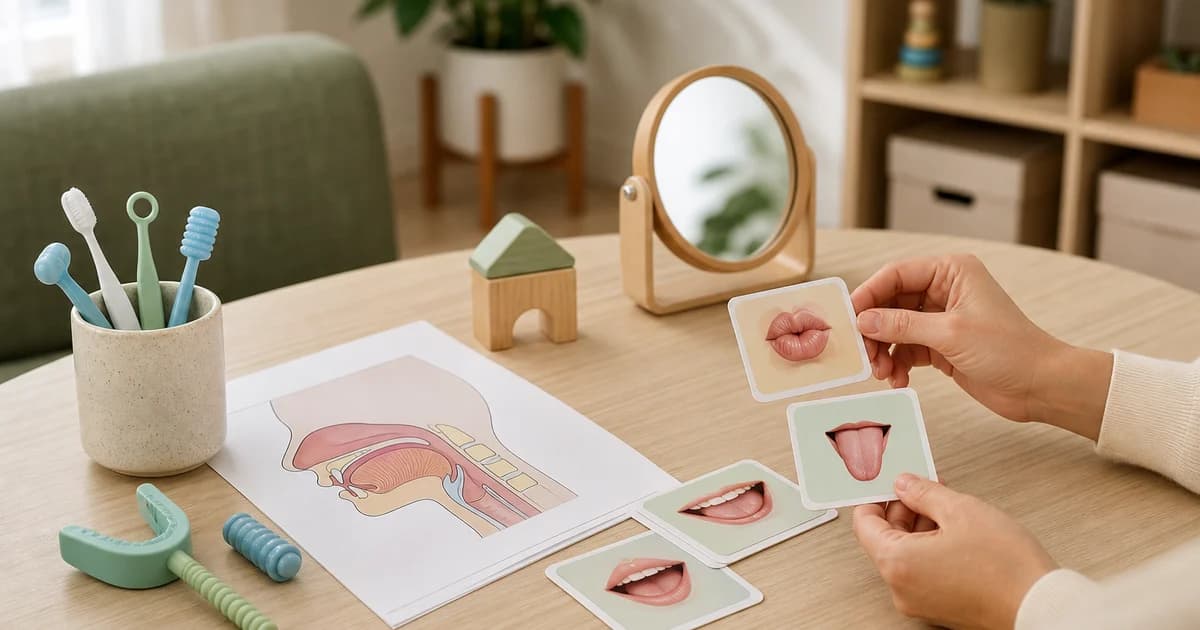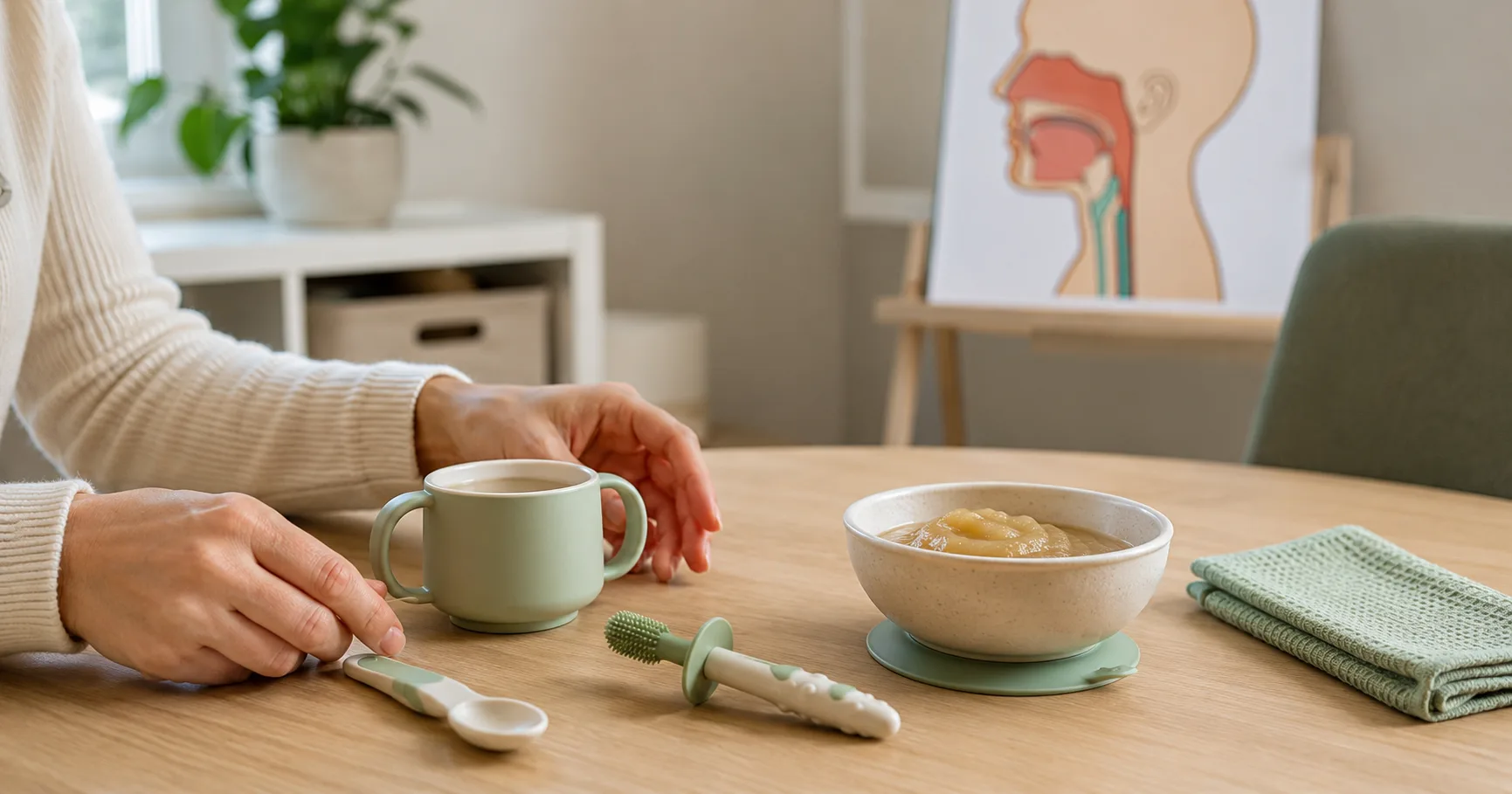
Dysphagia means difficulty swallowing safely and efficiently. In children, it may appear from the first days of life through school age. If feeds take a very long time, a child coughs or chokes during meals, or avoids specific textures, it is worth discussing feeding and swallowing with a speech therapist or neurologopedic specialist.
What is dysphagia in children?
Swallowing is a complex neuromuscular process involving coordinated work of the lips, tongue, jaw, soft palate, throat, larynx, breathing, and several cranial nerves. Clinically, it is usually described across oral, pharyngeal, and esophageal phases.
- Oral phase covers sucking, chewing, bolus formation, and moving food or liquid toward the throat.
- Pharyngeal phase covers triggering the swallow and protecting the airway while food passes through the throat.
- Esophageal phase covers movement through the esophagus toward the stomach.
Speech therapists and neurologopedic specialists mainly assess and support oral and pharyngeal swallowing. Esophageal symptoms require medical assessment, for example by a gastroenterologist, ENT specialist, or another physician.
Warning signs parents should not ignore
Signs vary by age and by the phase of swallowing that is affected. A consultation is especially sensible when feeding is consistently long, stressful, inefficient, or unsafe.
In infants and young children:
- feeds last more than 30-40 minutes and visibly tire the child,
- coughing, choking, pallor, or bluish lips appear during feeding,
- the child often vomits, regurgitates, or has food come through the nose,
- weight gain is poor despite regular feeding,
- breathing sounds wet, noisy, or congested during or after meals.
In preschool and school-age children:
- regular coughing or choking during meals or soon afterward,
- a wet-sounding voice after eating or drinking,
- strong texture restriction to only very soft or liquid foods,
- food pocketing in the cheeks or oral residue after swallowing,
- pain or discomfort reported during swallowing,
- recurrent respiratory infections without a clear medical explanation.
Choking needs assessment
What can cause swallowing difficulties in children?
Pediatric dysphagia rarely has one isolated cause. It is often shaped by several medical, motor, sensory, anatomical, and emotional factors. A careful history helps identify which of them matter for the child.
- Neurological factors, such as cerebral palsy, prematurity, perinatal injuries, neuromuscular conditions, or other central and peripheral nervous system difficulties.
- Anatomical and structural factors, such as cleft lip or palate, restricted tongue mobility, enlarged tonsils, or other airway and oral-structural differences.
- Sensory processing difficulties, where sensitivity or reduced awareness in the mouth makes textures, temperature, taste, or touch hard to tolerate.
- Behavioral and emotional factors, especially after a painful reflux episode, choking incident, medical procedure, or repeated stressful feeding experiences.
- Muscle tone and orofacial patterns, where weak or poorly coordinated work of the lips, tongue, jaw, or cheeks makes chewing and bolus transport harder. Related oral-function patterns are discussed in our article on mouth breathing in children.
How does a speech therapist assess swallowing?
Assessment starts with history: feeding from birth, bottle or breast patterns, diet expansion, difficult textures, mealtime duration, medical history, medications, vomiting or regurgitation, and previous specialist opinions.
The therapist then observes oral-motor function and, when appropriate, a trial meal. The assessment looks at lip, tongue, jaw, and cheek movement; swallow timing; breathing-swallow coordination; oral residue; coughing; and voice quality after swallowing.
In selected cases, instrumental assessment such as videofluoroscopic swallow study (VFSS/VFS) or fiberoptic endoscopic evaluation of swallowing (FEES) may be needed. These examinations are medical procedures, usually ordered by a physician and performed with specialist involvement.
If you are planning a first visit, our guide to preparing for a speech therapy assessment can help you collect useful information.
What can therapy include?
Therapy is always individualized. It depends on the child's age, cause of difficulty, symptom severity, medical context, nutrition, and whether cooperation with a physician, dietitian, physiotherapist, or psychologist is needed.
- Texture and consistency adjustments to find foods and liquids the child can manage safely, often using IDDSI terminology.
- Positioning during feeding, especially when muscle tone, head control, or breathing-swallow coordination are involved.
- Orofacial work supporting lips, tongue, jaw, cheeks, chewing, bolus formation, and oral transit.
- Sensory desensitization for children who struggle with texture, temperature, touch, or oral sensitivity.
- Parent coaching so feeding strategies are safe, realistic, and continued between sessions.
Progress follows the child
Electrostimulation and GOPEX: when can they support therapy?
In selected cases, adjunctive methods may support the therapy plan. They require individual qualification and do not replace active therapy or medical diagnostics.
Electrostimulation (ENMOT) may support selected muscles involved in orofacial function and swallowing. In swallowing difficulties, it should be considered only after assessment and as one part of a wider plan. We explain qualification and safety in our article on electrostimulation and taping in speech therapy.
GOPEX therapy organizes work on oral functions, breathing, swallowing coordination, and orofacial patterns. It can be included after therapist assessment. You can read more in our guide to GOPEX therapy for breathing and oral functions.
When is it worth visiting StacjaMowa in Gdansk?
A speech therapy or neurologopedic consultation is sensible when meals are consistently difficult, coughing or choking repeats, weight gain is a concern, the child accepts only very limited textures, or a physician has mentioned aspiration risk.
You can contact us through the contact form. If you are unsure which service fits best, start with GOPEX therapy or neurologopedic therapy.
Key takeaways
- Dysphagia means difficulty swallowing safely and efficiently, and it requires specialist assessment when symptoms repeat.
- Speech therapists support oral and pharyngeal phases; esophageal symptoms require medical assessment.
- Warning signs include regular choking, wet voice after meals, very long feeds, poor weight gain, and unexplained respiratory problems.
- Therapy may include texture adjustments, positioning, orofacial work, sensory support, and parent coaching.
Sources
The sources below are educational references. They do not replace diagnosis or an individual therapy plan.
- Szurek and Jamroz 2025: Neurogenic dysphagia, instrumental assessment, and integrated care (Logopedia, PTL)
- ASHA: Pediatric Feeding and Swallowing - Practice Portal
- Lefton-Greif 2008: Pediatric Dysphagia
- Matsuo and Palmer 2023: Anatomy and Physiology of Feeding and Swallowing
- IDDSI Framework
Want to learn more about therapy options?
Learn more about this therapyFrequently asked questions
- At what age can swallowing difficulties appear?
- Dysphagia can appear at any age: in newborns with sucking and swallowing difficulties, during diet expansion in infancy, or later in preschool and school age. The timing often helps guide further assessment.
- Can pediatric dysphagia go away without therapy?
- It depends on the cause. Some mild sensory feeding difficulties may decrease as a child matures, but dysphagia related to neurological, anatomical, or persistent feeding-skill difficulties usually needs active support and sometimes a multi-specialist plan.
- How does a speech therapist check swallowing?
- Assessment includes history, observation during a trial meal, and evaluation of oral-motor function, breathing-swallow coordination, residue, coughing, and voice quality. In selected cases, a physician may order VFSS/VFS or FEES with specialist involvement.
- Can swallowing difficulties affect speech development?
- They can be related. The lips, tongue, cheeks, jaw, and breathing patterns involved in feeding also support speech. A good speech therapy assessment looks at feeding, swallowing, oral function, and communication together.
- What is GOPEX and when is it used with dysphagia?
- GOPEX organizes therapy around breathing, swallowing coordination, and orofacial functions. It may be one element of therapy after individual qualification, but it is not a universal first-choice method for every child.
- When is a neurologopedic consultation needed?
- A neurologopedic consultation is especially useful when dysphagia is connected with cerebral palsy, prematurity, neurological injury, complex medical history, or broader developmental concerns. A speech therapist experienced in feeding and swallowing can also support motor, sensory, and behavioral feeding difficulties.
- How should I prepare for the first swallowing consultation?
- Bring information about medical history, previous tests, typical meals, difficult textures, feeding duration, and symptoms such as coughing or vomiting. A short video of a typical meal can also help the therapist understand what happens at home.