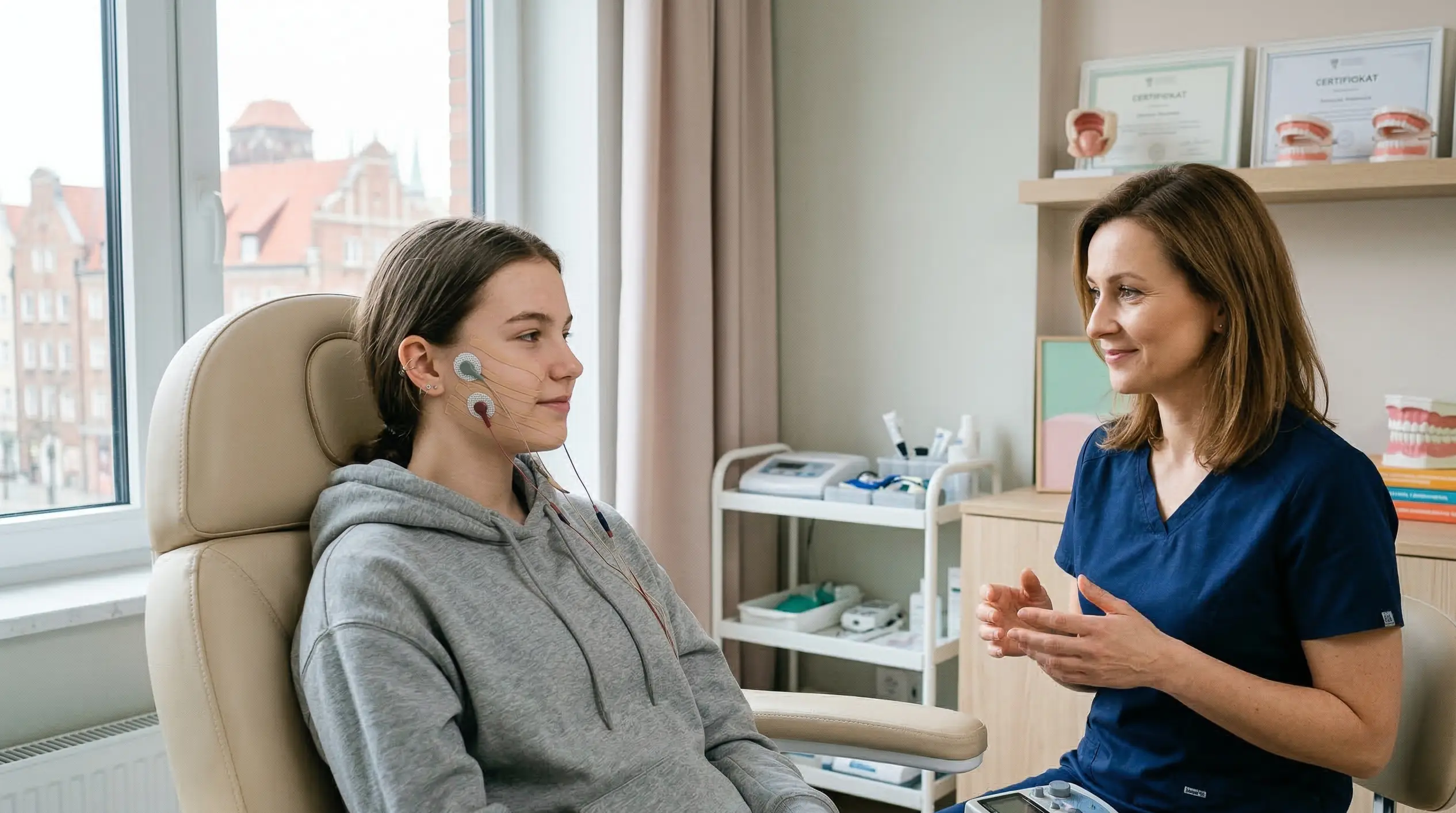
Electrostimulation and therapeutic taping are supportive tools in speech therapy, not standalone treatment plans. When used after proper qualification, they may help work on oral muscle function, articulation, swallowing, and facial symmetry. Their value depends on clinical indication, safety screening, and integration with active therapy.
What these methods mean in speech therapy
In clinical speech-therapy settings, electrostimulation typically uses individually selected low-intensity current to support neuromuscular activation. Taping applies elastic therapeutic tape to guide movement patterns and sensory feedback in selected areas.
Both methods are adjuncts. They are not replacements for diagnostic work, structured exercises, and regular therapist-patient practice.
When these methods may be considered
Depending on assessment findings, they may be considered when there is:
- reduced oral-motor control affecting articulation,
- muscle imbalance affecting lip or tongue function,
- need for additional facilitation in dysphagia-related work,
- a broader neurologopedic rehabilitation plan where adjunctive methods can improve functional training.
Contraindications and safety first
Qualification always comes before intervention. The therapist reviews health status, potential contraindications, and treatment goals. In some cases, additional medical consultation is required before introducing electrostimulation.
Contraindications
Learn more about our ENMOT electrostimulation service.
No one-size-fits-all protocol
When these methods help and when they do not
Supportive methods are most useful when they are part of a clear functional plan and combined with active exercises.
Most useful when:
- the patient is qualified after structured assessment,
- goals are specific and measurable,
- home program and active therapy continue in parallel.
Usually not useful when:
- they are treated as a replacement for regular therapy,
- there is no diagnostic indication,
- contraindications are not reviewed.
How StacjaMowa implements adjunctive methods
At StacjaMowa, decisions on electrostimulation or taping are always assessment-based and linked to practical communication or swallowing goals. Safety, informed consent, and realistic expectations are central throughout the process.
How to combine them with daily therapy work
The best outcomes typically come from combining adjunctive methods with classical speech therapy, caregiver education, and consistent home practice. For myofunctional context, read our guide to myofunctional therapy and MFS stimulators.
When articulation disorders such as lisping in children are present, electrostimulation may complement oral-motor exercises.
If your concern is delayed speech in younger children, our article on when to seek pediatric speech support gives a practical decision checklist.
Key takeaways
- Speech-therapy electrostimulation is a supportive method - it always requires specialist qualification.
- Therapeutic taping supports muscles but does not replace active exercises.
- Both methods have contraindications - they are not suitable for every patient.
- The best outcomes come from combining electrostimulation with regular speech therapy.
Sources for further reading
- Tavakoli et al. (2023). NMES with conventional swallowing therapy - PubMed (PMID 37231810)
- Logopedia (Polish Logopedic Society journal): swallowing disorders article (OA)
- NHS: Swallowing problems (dysphagia)
Book a consultation with realistic expectations
If you are considering electrostimulation or taping, the safest first step is a consultation focused on indication, contraindications, and expected functional outcomes.
You can review service details on speech therapy and reach us through the StacjaMowa contact page.
Want to learn more about therapy options?
Learn more about this therapyFrequently asked questions
- Is speech-therapy electrostimulation painful?
- Usually not. Most patients describe it as mild tingling or vibration. Parameters are individualized to keep treatment safe and tolerable.
- Is every patient with speech difficulties a candidate?
- No. Qualification depends on functional assessment, health status, and treatment goals. In some cases, conventional therapy should come first.
- Do I need medical clearance before electrostimulation?
- Sometimes yes, especially with comorbidities or potential contraindications. The therapist decides after history review and clinical screening.
- How long is one electrostimulation session at StacjaMowa?
- The standard session is about 30 minutes. It is usually embedded in a broader therapy plan that includes active exercises and home practice.
- Can therapeutic taping be done independently at home?
- Taping should be introduced and supervised by a qualified specialist. Unsupervised application may be ineffective or reinforce unfavorable patterns.
- Can electrostimulation and taping replace speech therapy?
- No. They are supportive methods and work best together with structured speech therapy, functional training, and consistent home exercises.