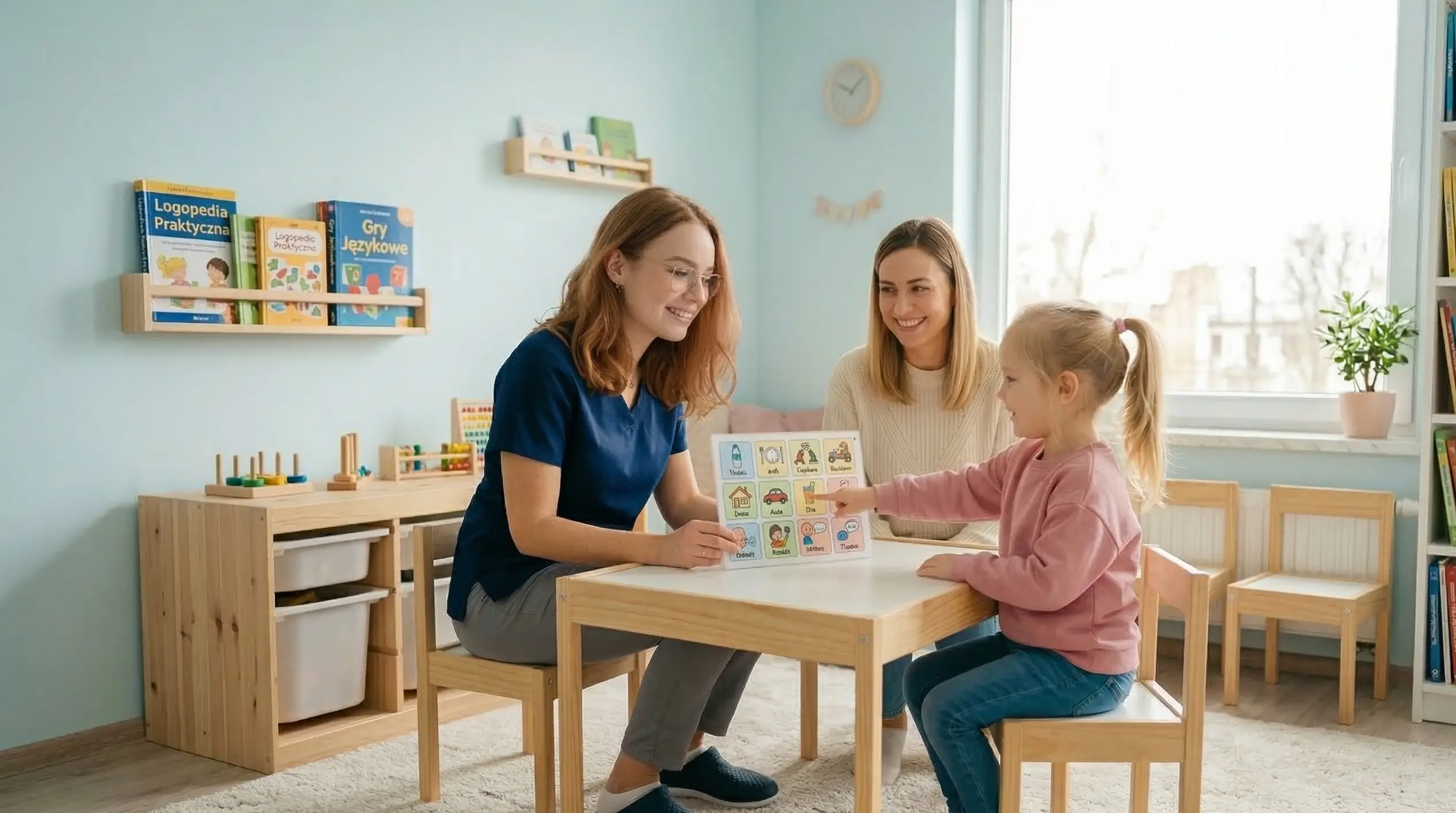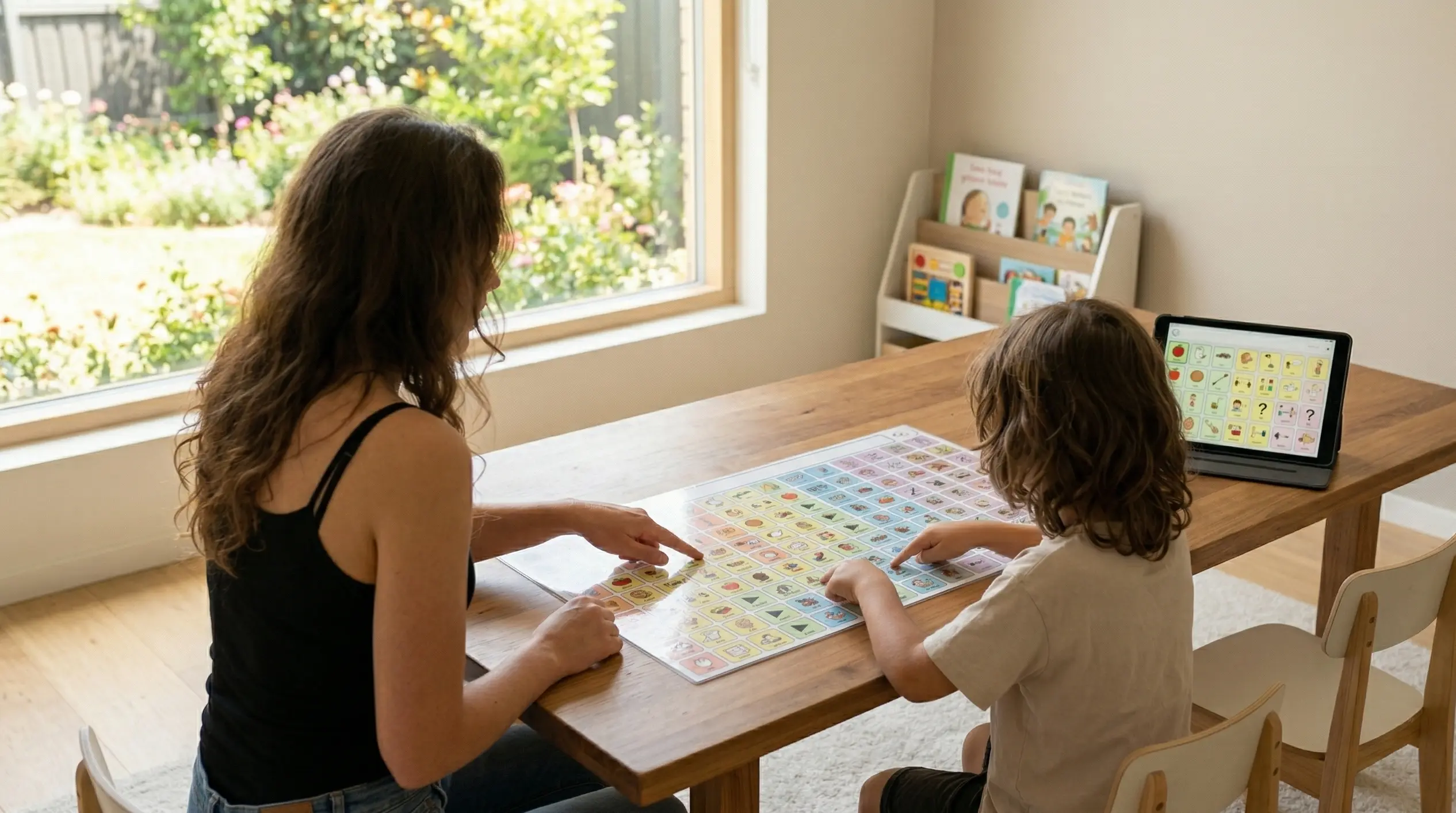
AAC, or augmentative and alternative communication, does not replace speech. It helps a child express needs, emotions, and choices when words are not enough yet. A well-matched AAC system can reduce frustration, strengthen communication intent, and create a practical bridge between what the child wants to say and what they can currently say out loud.
What AAC is and who it is for
AAC includes all communication methods that go beyond spoken words. These may include gestures, manual signs, pictures, communication boards, symbol books, speech-generating apps, or dedicated devices. AAC is called augmentative when it supports speech, and alternative when it becomes the main communication channel.
Children may benefit from AAC in very different clinical profiles: autism spectrum conditions, delayed speech development, cerebral palsy, childhood aphasia, dysarthria, or other neurological communication difficulties. The goal is not to "teach pictures" but to give the child a real way to request, refuse, comment, choose, and connect.
If you want the broader introduction first, read our earlier guide on AAC when a child is not speaking yet.
AAC and speech development: the myth worth dropping
Many parents worry that giving pictures or a tablet will make the child stop trying to speak. Current clinical guidance and published evidence do not support that fear. Well-led AAC does not take motivation away from speech. It expands communication options and lets the child experience being understood.
That matters because a child who can successfully communicate "more", "finished", "help", or "hurts" often has less tension and more readiness for interaction. In that sense, AAC may support language development rather than block it. If spoken language potential is there, speech usually remains the fastest and easiest option for the child.
Important for parents
When it makes sense to consider AAC
AAC is worth considering when a child:
- is not speaking or uses only a few words after age two or three, while relying mainly on crying, shouting, or pulling an adult by the hand,
- has autism, complex neurological needs, or another developmental profile with limited verbal communication despite therapy,
- does speak, but speech is so unclear that people around the child keep guessing the message,
- has lost part of previously used speech or shows a clear regression in communication,
- needs a practical way to reduce frustration and increase day-to-day agency quickly.
There is no single perfect age cutoff. What matters is not the calendar, but the child's actual communication needs. If the family is also noticing markers typical of delayed speech development, AAC consultation may become part of a broader support plan.
How AAC assessment and selection work in StacjaMowa
AAC assessment starts with identifying the signals the child already uses. The therapist observes eye gaze, gesture, vocalizations, request patterns, response to choice-making, and understanding of simple spoken messages. Motor access matters too: can the child point, touch, move symbols, tolerate a screen, and handle the pace of interaction?
The second part is a detailed parent interview covering previous therapy, everyday routines, difficult situations, and family expectations. This is why AAC selection should not be random. In some cases simple picture boards are the best first step, in others a communication book or a set of functional gestures.
High-tech options such as speech-generating apps or tablet-based systems are usually considered later, when they fit the child's motor, sensory, and cognitive profile. At StacjaMowa, AAC is always linked to the wider communication picture rather than offered as an isolated tool.
Family role: without communication partners, the system will not work
Even a well-selected AAC system may end up unused if adults do not bring it into everyday routines. Children learn AAC mainly through modeling, which means the parent or therapist points to symbols, uses gestures, or offers choices while speaking naturally.
In practice, parents support AAC when they:
- show a symbol or gesture while saying the same word aloud,
- pause long enough for the child to respond,
- reinforce every communication attempt, even if the message is still imperfect,
- keep the AAC tool within reach during meals, play, dressing, and going out,
- regularly review which words and symbols are actually functional right now.
Small steps work best
AAC at home and in preschool: practical examples
AAC develops best in ordinary routines rather than only at a therapy table. That is when the child has a real reason to communicate.
- at mealtime the child can choose between two foods, ask for "more", or signal "finished",
- during play the child can choose a toy, request "again", or decide what happens next,
- during hygiene routines the child may show "stop", "scared", or "break",
- before going out the child may point to "playground", "home", or "cold".
It also helps when preschool staff know the core AAC rules. Children do better when home and preschool follow similar communication expectations instead of starting from scratch in every environment.
AAC in StacjaMowa: how it connects with other therapies
In StacjaMowa, AAC is not treated as a separate island. It is part of a coordinated communication plan. Children may work on speech therapy goals such as vocabulary, understanding, and sentence building while also using AAC, and more complex profiles may require neurologopedic input as well.
When communication needs overlap with oral-function difficulties, the plan may also include myofunctional therapy or other oral-motor support. If hand function or sensory processing affects access to communication tools, hand therapy may also be relevant, as described in our article on hand therapy and speech support.
For direct service details, see our page on AAC support in Gdansk.
How to book an AAC consultation and what to expect
The first consultation is diagnostic and planning-focused. The therapist observes the child in simple activities, checks how the child responds to choices, reviews current communication strategies, and discusses the strengths and limits of gestures, symbols, and digital systems with the family.
Families do not receive unrealistic promises. They receive a realistic starting plan: a few core symbols or gestures for home use, basic modeling strategies, and the next review steps needed to expand the system safely and meaningfully.
If the child has broader neurological communication needs, it may also help to review support through the perspective of a neurologopedic speech therapist in Gdansk.
Key takeaways
- AAC supports or replaces speech when spoken language alone is not enough for effective communication.
- Well-led AAC does not block speech development and may reduce communication-related frustration.
- Good AAC implementation depends on assessment, small steps, modeling, and active family participation.
- In StacjaMowa, AAC is integrated with speech therapy, neurologopedic therapy, and other support when needed.
Sources and further reading
The materials below are educational references that help families build a clearer understanding of AAC. Choosing the right system always requires direct assessment and observation.
- ASHA: Augmentative and Alternative Communication (AAC)
- Romski, Sevcik et al.: AAC and early language development
- Cress C., Marvin Ch. (2003). Common Questions about AAC Services in Early Intervention. Special Education and Communication Disorders Faculty Publications, 88.
- AAP HealthyChildren: AAC for children - parent guide
- Avalon Foundation: AAC overview
Want to learn more about therapy options?
Learn more about this therapyFrequently asked questions
- Is AAC only for autistic children?
- No. AAC may support children with delayed speech development, cerebral palsy, aphasia, dysarthria, and other conditions that make communication difficult. What matters most is matching the system to the child, not the diagnosis label alone.
- Can I introduce AAC if my child already says a few words?
- Yes. AAC can support children who use some words but still cannot clearly express needs, emotions, and choices. It helps organize communication and reduce frustration rather than taking speech away.
- What is the best age to start AAC?
- There is no single ideal age. The decision should be based on actual communication needs, not on calendar age alone. If speech is not enough for everyday communication, AAC is worth discussing early.
- Does introducing AAC mean giving up on spoken language?
- No. AAC gives the child a way to communicate now, not a reason to stop speaking. If spoken-language potential is present, AAC can act as a bridge that supports language growth and day-to-day participation.
- What if preschool staff do not know AAC yet - does it still make sense to start?
- Yes, because home is still the main communication environment for most children. The therapist can help the family prepare a simple guide for preschool staff and define realistic first steps for broader implementation.
- How long does it take to learn AAC?
- It depends on the child’s profile, the chosen tools, and how consistently the system is used across environments. Some children show first functional changes within weeks, while others need longer. Consistency in everyday situations matters more than speed.