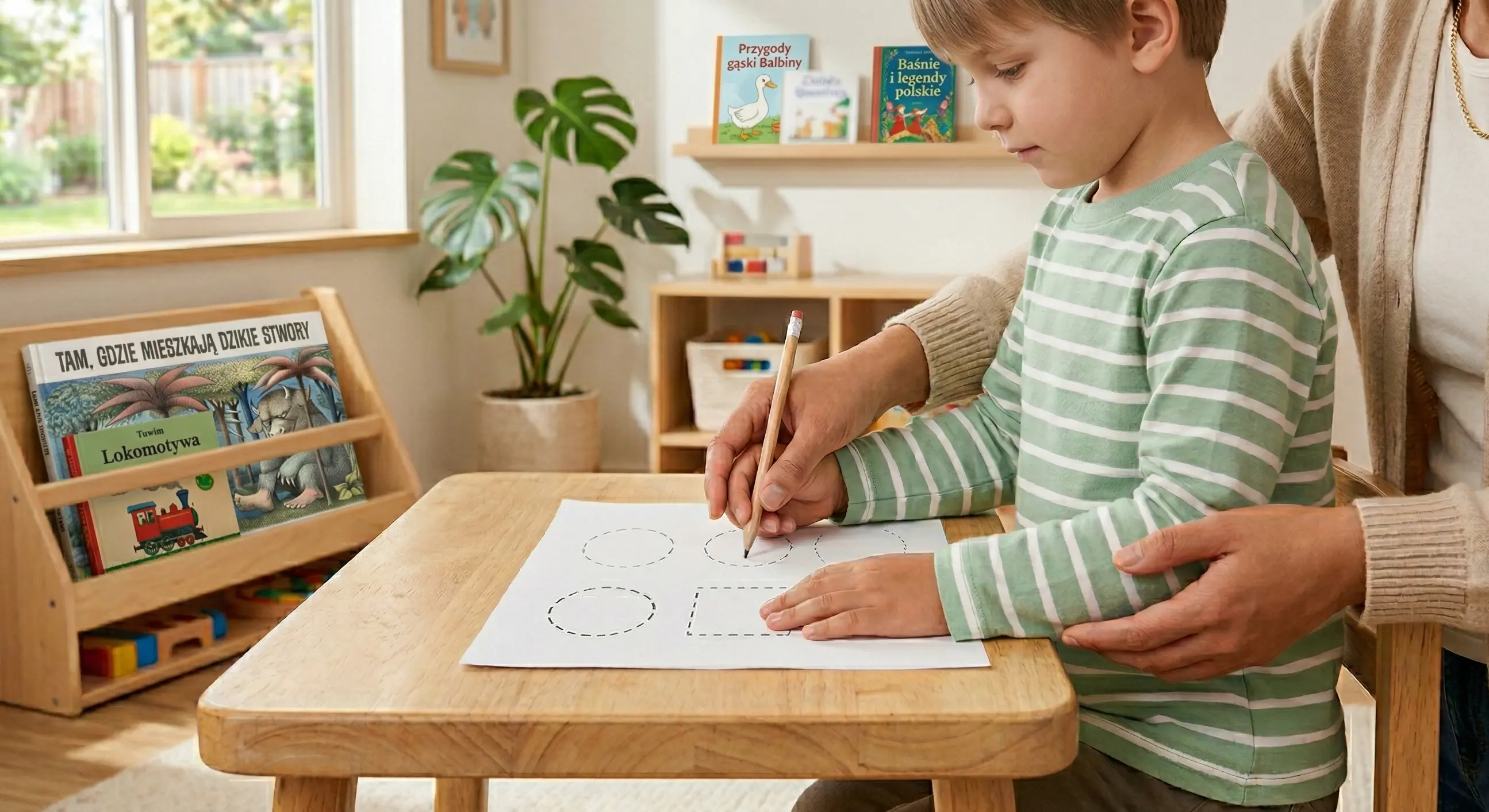
Hand therapy supports more than a good grip and neat handwriting. It also helps with movement planning, concentration and a child's independence. The link between hand skill and speech development is not a coincidence: a growing body of research shows that fine motor skills and language development often go hand in hand, which is why it is worth looking at a child's difficulties more broadly than through drawing or writing alone.
What is hand therapy?
Hand therapy is a form of support aimed at improving the function of the hand, fingers, wrist and the whole upper limb, as well as their coordination with the eyes and trunk. In practice it is not only about the hand itself, but about preparing the child for everyday activities: drawing, cutting, doing up buttons, eating with cutlery, and later writing.
At StacjaMowa, hand therapy also includes work on posture, muscle tension and movement organisation. This matters because a child without a stable trunk, or one who tires quickly at the table, often spends most of their effort just holding the position, leaving little left for the precise task the hand needs to do.
During assessment, the hand therapist looks at, among other things:
- how the child sits at the table and trunk stability,
- muscle tension and smoothness of movement,
- pencil grip and drawing pace,
- precision of manipulation, for example with puzzles and cutting,
- the eye-hand coordination needed for school tasks.
A signal worth taking seriously
How are fine motor skills connected to speech development?
Motor development and language development do not happen in isolation from each other. A child explores the world through action: reaching, grasping, arranging, opening, inserting, building and trying things out. Every such activity creates a natural opportunity to name objects, ask questions, request help and comment on what is happening.
A more capable hand usually means greater independence in play and in everyday tasks. Greater independence, in turn, supports communication, because the child initiates contact more often, is more willing to talk, and engages more easily in activities where language appears naturally. This is one of the reasons why manual and language difficulties often occur together.
In clinical practice, another mechanism is also visible: both hand skill and speech require sequence planning. First one movement, then the next, adjusting pace, controlling precision and reacting to the result. Similar organisational processes are needed when building an utterance and ordering information in a sentence.
If you want to read more about signs of delayed language development, see also our article on delayed speech development: when a child speech therapist is needed.
Hand therapy and readiness for learning to write
Readiness to write is not just about knowing the letters. A child needs a stable posture, adequate hand strength and precision, eye-hand coordination, and the ability to concentrate on a task for several minutes or more. When any of these elements is weaker, writing becomes tiring and frustrating.
Children with fine motor difficulties often:
- press the pencil too hard or too lightly,
- tire quickly during colouring and drawing,
- have difficulty staying within the lines,
- avoid table-based tasks and keep putting them off,
- get frustrated when the result does not match the effort put in.
In such situations, combining hand therapy with speech therapy and pedagogical therapy can be especially helpful. Hand therapy strengthens the motor foundation, pedagogical therapy supports readiness for reading and writing, and the speech therapist works on language comprehension and expression.
When is it worth referring a child for hand therapy and to a speech therapist?
It is worth considering a consultation if your child:
- has difficulty holding a pencil, scissors or cutlery,
- tires quickly during drawing, cutting or arranging small objects,
- avoids activities that require hand precision,
- is described at nursery as trying very hard but not keeping up with art activities,
- at the same time talks less than peers, or has difficulty building sentences or with pronunciation.
For many families, a good starting point is a speech therapy or neurologopedic consultation. The specialist then assesses not only speech itself, but also the child's general way of functioning: attention, motor skills, play style, muscle tension and readiness for table-based tasks. If indications appear, hand therapy or pedagogical therapy can be introduced alongside it.
The earlier, the calmer
What do hand therapy sessions at StacjaMowa look like?
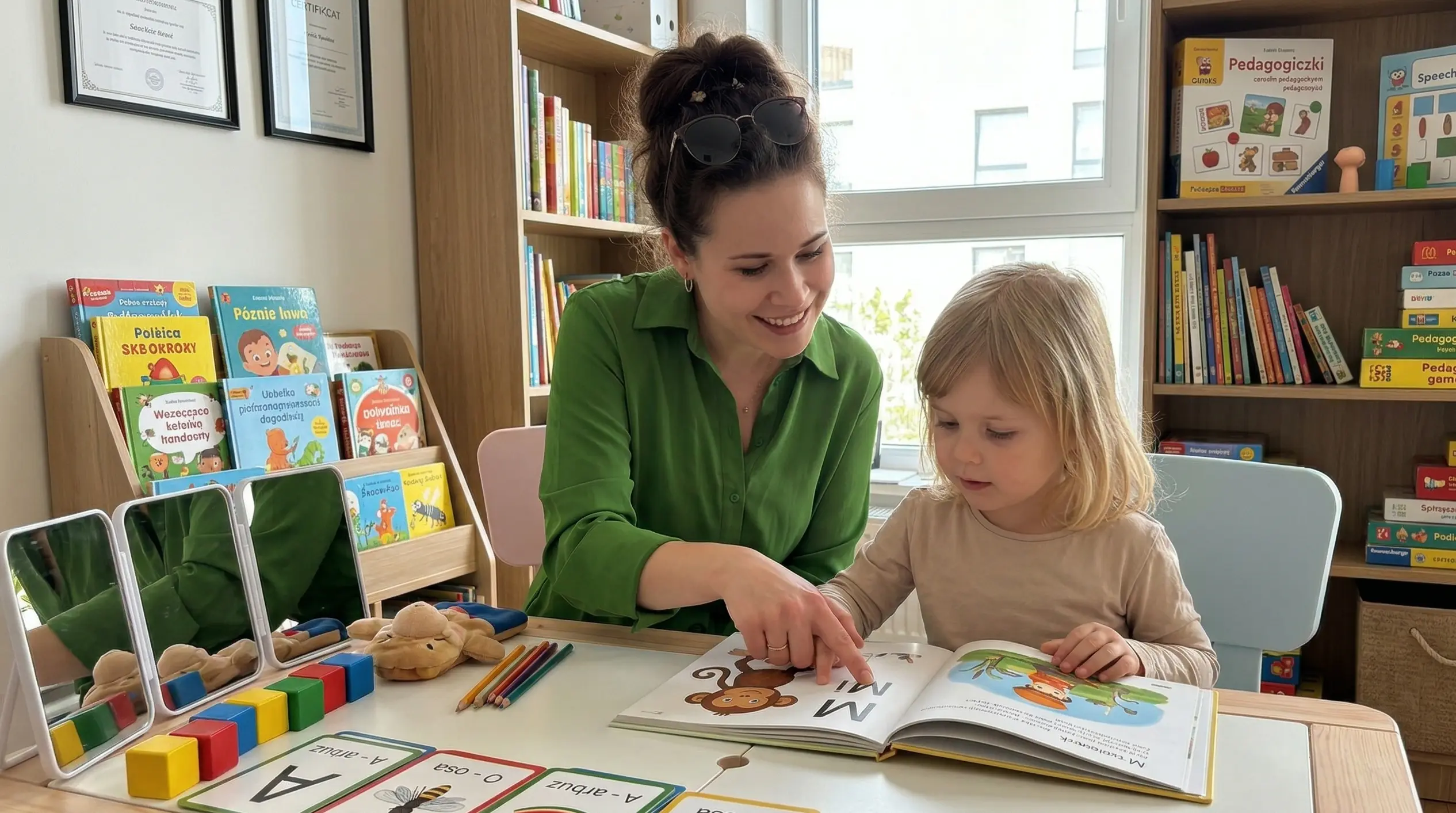
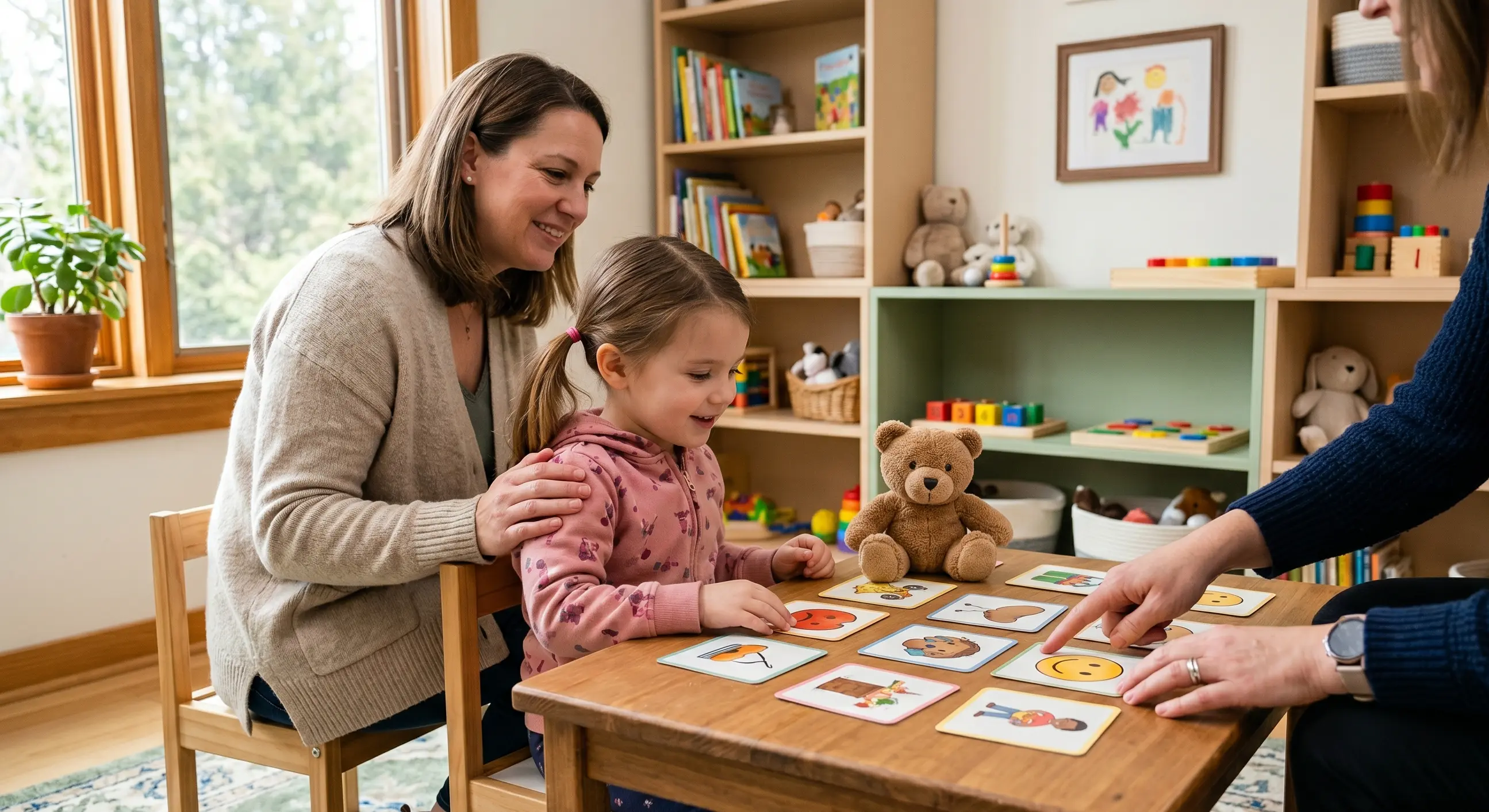
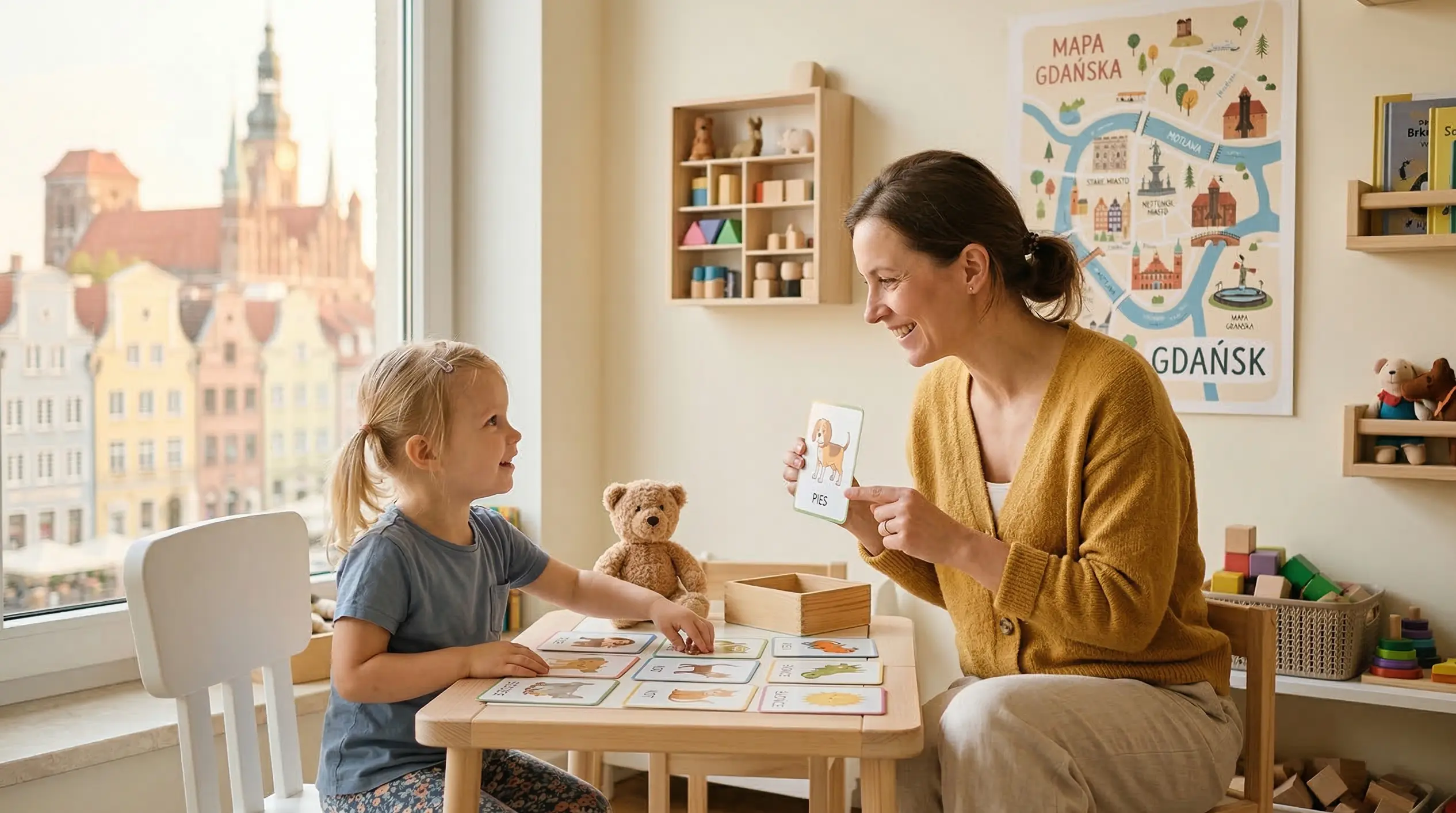
Sessions have a friendly, play-based form, but are based on assessment and specific functional goals. First, the therapist observes the child in free play and simple tasks at the table. They then decide what to work on first: grip, endurance, movement planning, preparation for writing, or self-care skills.
During therapy, whole-body activities are combined with tasks requiring hand precision. These may include obstacle courses, stabilisation exercises, play with modelling dough, pegs, tweezers, puzzles, or simple graphomotor tools. This way the child practises not only the hand, but also the movement organisation needed at nursery and school.
Depending on needs, hand therapy can be combined with other forms of support. A natural complement is our article on how to prepare a child for learning to read and write, which shows how to build school readiness without pressure and without reducing the whole process to practising letters.
Home activities that support both the hand and speech
Not all help has to start at a table with worksheets. At home, you can do a great deal through short, regular activities that strengthen the hand while also encouraging talking.
- Finger rhymes with a simple rhyme support rhythm, fluency and coordination.
- Playdough, modelling dough or salt dough develop hand strength, and at the same time encourage the child to talk about what they are making.
- Threading, sorting and doing up buttons can be combined with counting, naming colours and simple instructions.
- Drawing a plan for the day or a child's own story gives an opportunity to practise grip and build vocabulary.
If a child needs additional ways to express needs and choices, our article on when a child still isn't talking - how AAC communication works may also help.
Why does cooperation between specialists matter?
In children with difficulties in speech and writing, it is rarely a single, isolated problem. More often several elements overlap: muscle tension, coordination, sensory regulation, language development, emotions, and school experiences. That is why the best results come from a therapy plan in which specialists work towards a shared goal.
The hand therapist builds the motor foundation, the speech therapist supports speech and communication development, and the pedagogical therapist helps with readiness for reading, writing and learning. This way the child does not receive a random set of exercises, but consistent support matched to everyday functioning.
Key takeaways
- Manual and language difficulties often occur together, so it is worth looking at a child's development as a whole.
- Hand therapy supports not only handwriting, but also independence, concentration and school readiness.
- The best results usually come from combining hand therapy, speech therapy and pedagogical therapy.
- Short, regular activities at home can complement clinic-based work well.
Want to learn more about therapy options?
Learn more about this therapyFrequently asked questions
- My child is 5, tires quickly during drawing and dislikes table-based tasks. Is this something to worry about?
- It is worth checking. Tiring quickly during simple manual tasks can point to difficulties with fine motor skills, posture, or movement planning. If speech or writing-readiness difficulties appear at the same time, it is a good idea to consider a combined hand therapy and speech therapy consultation.
- Is hand therapy needed if a child's handwriting is simply untidy?
- Hard-to-read handwriting can sometimes be a sign of deeper difficulties, for example with trunk stability, muscle tension, or eye-hand coordination. Hand therapy can help not only improve the handwriting itself, but also reduce the effort a child puts into every letter.
- Can hand therapy also improve speech?
- Hand therapy does not replace speech therapy and is not used directly to elicit sounds. It can, however, support general movement organisation, planning and regulation, which also matter for language development. That is why it often works best as part of a broader therapy plan.
- How long does hand therapy take?
- This depends on the child's difficulties, the goal of therapy, and how regularly the work is done. For some children, a few months of systematic sessions is enough; for others, support continues longer and also includes home exercises and cooperation with other specialists.
- Can I just practise with my child at home instead of going to therapy?
- Home activities are very important, but they cannot replace an assessment and an individual work plan. The best results come from combining short, well-chosen activities at home with therapy led by a specialist.