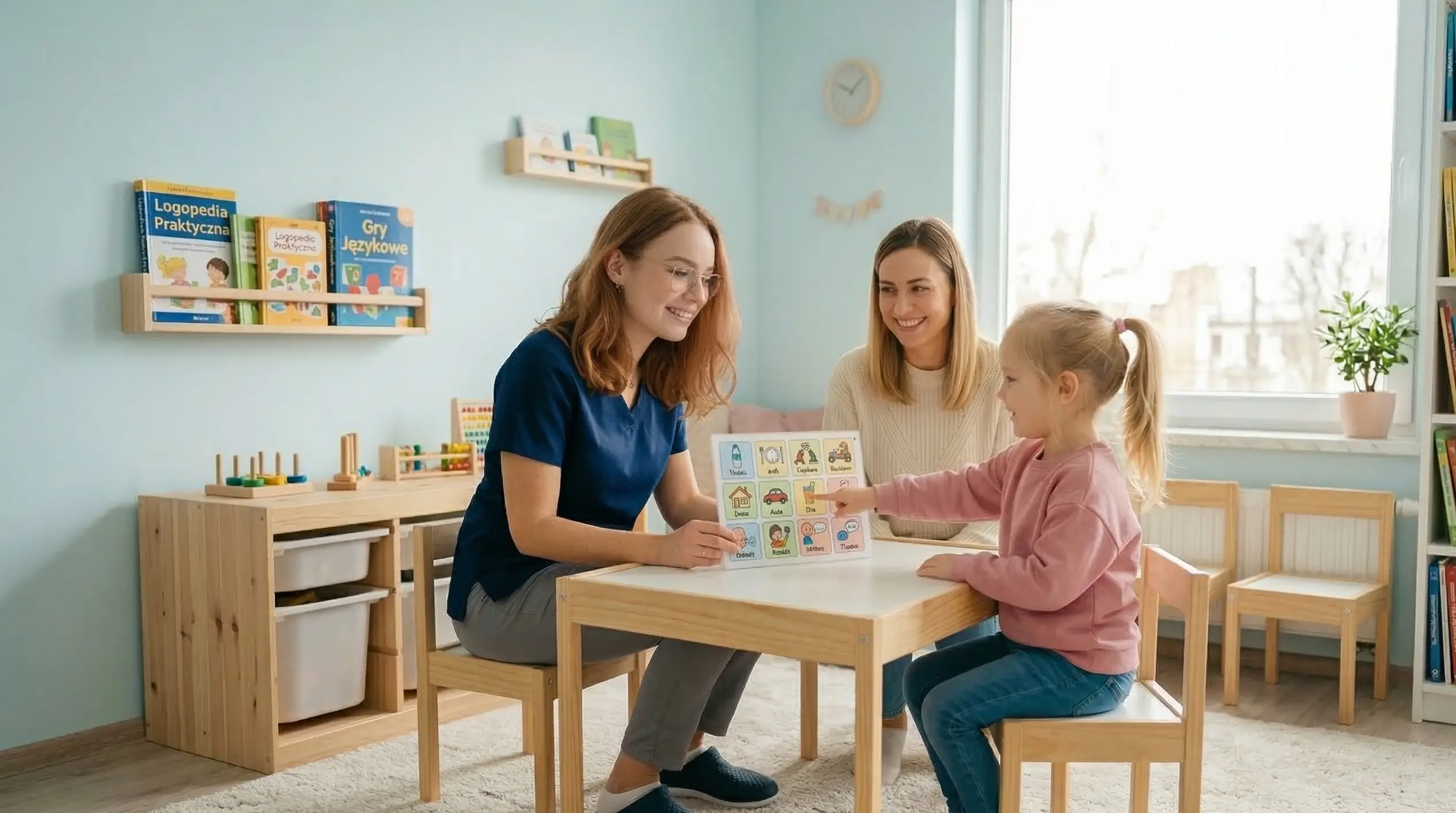
If a child is not speaking yet, it does not mean they have nothing to communicate. Augmentative and Alternative Communication (AAC) offers practical tools to express needs, feelings, and choices now, before spoken language appears or while it is still developing. For many families, AAC reduces daily frustration and creates clearer interaction.
What AAC means in simple terms
AAC includes methods that support speech or temporarily replace it when speaking is very difficult. In practice, this can include gestures, picture symbols, communication books, boards, or tablet-based apps.
The goal is functional communication in everyday life, not using tools for their own sake. A good AAC system helps a child request, refuse, comment, ask, and participate in relationships.
Who can benefit from AAC?
AAC is used with children and adults across different communication profiles:
- delayed speech and language development, including situations similar to those described in our article on delayed speech development,
- autism spectrum profile, intellectual disability, cerebral palsy, and complex developmental needs,
- neurological conditions after stroke or brain injury where spoken language is limited.
AAC should go beyond yes/no responses. It should support real participation, preferences, emotions, and decision-making in daily routines.
A common parent concern
Does AAC block speech development?
AAC is not a competitor to speech. It is a bridge that helps the child communicate effectively while language is still emerging. When a child feels understood, emotional pressure usually decreases and learning opportunities increase.
At StacjaMowa, AAC is integrated with speech and neurologopedic support when needed, similarly to our broader approach described in the article on speech rehabilitation after stroke.
How AAC is introduced step by step
AAC implementation starts with assessment of current communication: eye-contact quality, understanding of simple language, interest in symbols, and ways the child initiates interaction.
Together with parents, the therapist chooses an AAC format that is realistic for daily use:
- functional gestures and simple signals,
- picture symbols or a communication book,
- a communication board,
- an app or speech-generating solution when appropriate.
Parents receive practical scenarios for meals, dressing, play, and transitions. AAC works best where life happens every day, not only in the therapy room.
Why specialist guidance matters for AAC
Choosing random symbol sets or apps from the internet can overload the child or create a system that does not match cognitive and language readiness.
In StacjaMowa, an AAC-experienced therapist helps families:
- match symbol complexity to developmental stage,
- build the first functional vocabulary for daily routines,
- teach consistent communication modeling at home and in preschool.
How parents can support AAC at home
- model symbols in routine situations even before independent use,
- start with a small core vocabulary and expand gradually,
- pause and reinforce every communication attempt,
- keep similar AAC rules across home and educational settings,
- review progress regularly and update the symbol set.
Tip for parents
For a broader communication-support perspective, see our article on delayed speech development.
Key takeaways
- AAC does not block speech development - research shows it can support language growth.
- Choosing the right AAC system always requires individual assessment by a speech therapist.
- Home environment (modeling, repetition) is as important as in-clinic therapy.
- Early AAC introduction lets the child communicate needs and reduces frustration.
When to book an AAC consultation in Gdansk
If your child struggles to express needs, often reacts with frustration, or avoids communication, it is worth consulting earlier rather than waiting many months. Early AAC support can quickly organize daily communication and give the family a concrete action plan.
You can read more on our AAC support service page. In some cases, AAC is also combined with speech therapy and, when relevant, with the approach described in myofunctional therapy with MFS stimulators.
Want to learn more about therapy options?
Learn more about this therapyFrequently asked questions
- Is AAC only for children who do not speak at all?
- No. AAC can also support children who use a few words but cannot build functional messages. The system is matched to current communication needs, not to a fixed label.
- Will AAC make my child stop trying to speak?
- When introduced well, AAC supports speech development rather than replacing it. Being understood often lowers frustration and creates more opportunities to practice language.
- At what age can AAC be introduced?
- There is no single age threshold for every child. The decision depends on communication profile, developmental readiness, and the ability to use simple symbols, gestures, or choices.
- Do parents need to buy a tablet and paid app immediately?
- Not necessarily. Many families begin with low-tech options such as gestures, boards, or communication books. Digital tools are added later when clinically justified.
- How long does AAC learning take?
- Progress is individual and depends on how consistently AAC is used in daily routines. Results are usually stronger when home and educational settings follow similar communication rules.
- Can AAC be combined with speech therapy?
- Yes, and this is common practice. AAC supports functional communication while speech therapy works in parallel on language understanding, expression, and verbal speech skills.