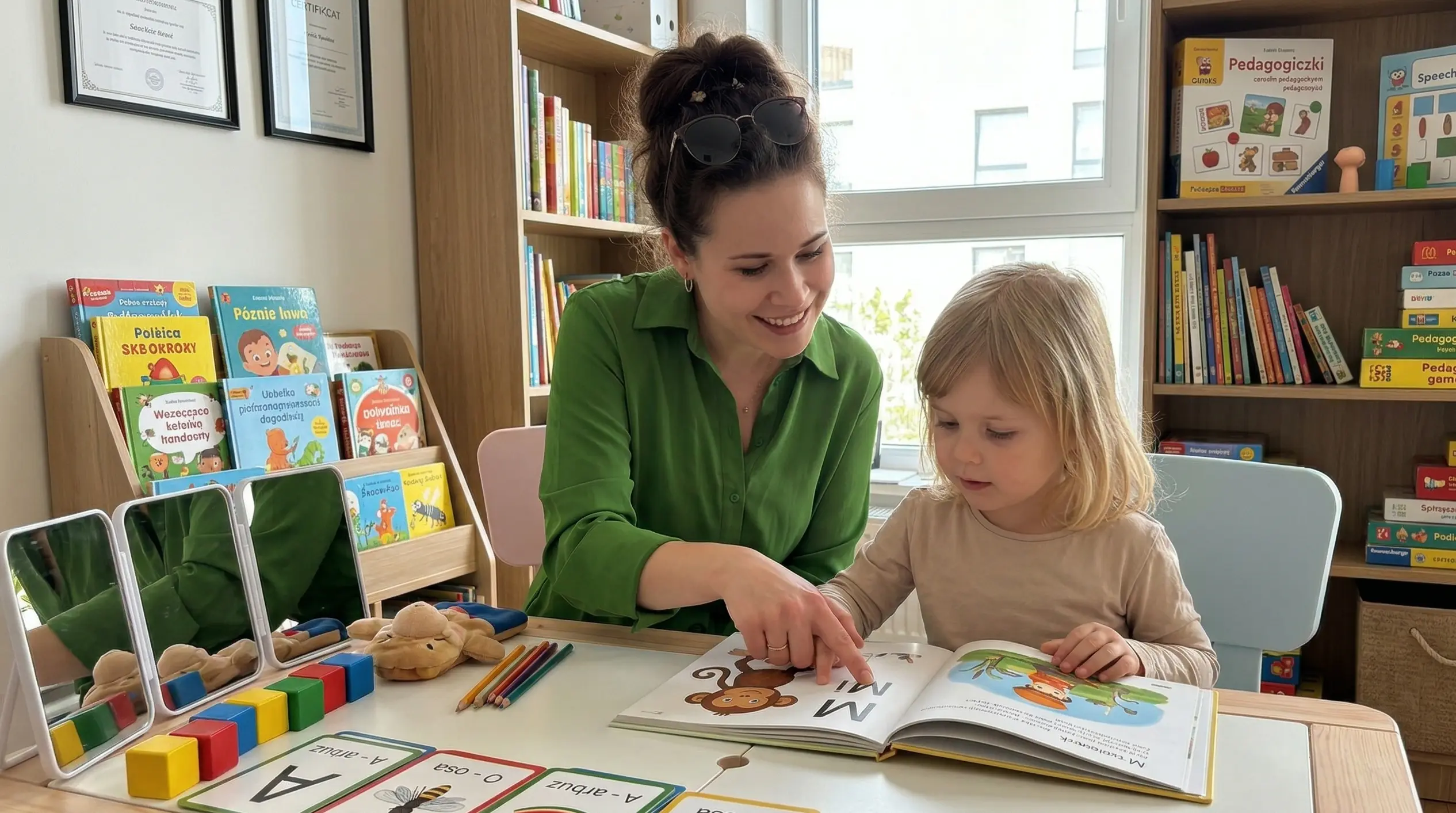
Readiness to learn reading and writing does not begin in Year 1 - it starts much earlier, in conversations, play, movement and the child's everyday experiences. What matters most is not knowing the letters themselves, but language, attention and hand skill, on which school then builds formal learning. At StacjaMowa in Gdańsk, a speech therapist and a pedagogical therapist help assess these foundations and choose support without unnecessary pressure.
What does readiness for reading and writing mean?
Readiness for learning to read and write is a set of skills that make it easier for a child to make use of what school offers. It includes understanding speech, vocabulary, the ability to narrate, attention, fine motor skills, and early pre-reading skills such as noticing rhymes or sounds in words.
A child who is ready to learn does not need to read or write before school. What matters more is being able to listen to a short story, answer simple questions, copy basic shapes, and hold a reasonably stable grip on a crayon. These are the skills that create a safe start at school.
Which language skills are the foundation of reading?
Reading and writing grow out of spoken language. If a child has difficulty understanding instructions, building sentences, or narrating, difficulties with reading comprehension, spelling, and producing written text independently tend to follow later.
In practice it is worth looking at four areas:
- understanding speech and longer instructions,
- vocabulary from everyday situations,
- building sentences and simple stories,
- phonological awareness, meaning the ability to play with rhyme, syllables and individual sounds.
If you notice that your child has a very limited vocabulary or gets lost in longer utterances, start with a speech therapy consultation. A good complement is also our article on delayed speech development, which shows when language development needs an earlier diagnosis.
A daily habit that really helps
The speech therapist's role before starting to learn reading and writing
A speech therapist does not only work on eliciting sounds. Before school starts, their role also includes assessing language, phonological hearing, and orofacial functions that support later reading, writing, and the child's general functioning in the classroom.
During a consultation at StacjaMowa, the speech therapist can:
- assess speech and language development relative to the child's age,
- check rhymes, syllables, and the ability to isolate the first sound in a word,
- note breathing, swallowing, and tension around the mouth and tongue,
- plan language games for home matched to everyday life.
If the difficulty concerns not only language but also articulation, you can also look at our article on lisping in children. In many cases, an earlier consultation helps avoid a situation where the child starts hearing at school that they simply cannot keep up.
The role of pedagogical therapy - when is work at home alone not enough?
Pedagogical therapy focuses on school skills: reading, writing, concentration, and organising material, always in relation to the child's individual abilities. It is especially helpful when, despite attempts at home, the child still has difficulty recognising letters, joining them into words, copying, or remembering letter shapes.
In practice, combining specialists works best. The speech therapist helps build the language foundation, and the pedagogical therapist uses that foundation while working on letters, reading and writing. If you want to see what this form of support looks like, see the description of pedagogical therapy in Gdańsk.
Some children also need parallel support with hand skill and postural tension. In that case, it is worth considering hand therapy, and when the difficulties concern sensory processing and regulation, also sensory integration.
Ways to support your child at home - what really works?
Short, calm activities woven into everyday life work best. The point is not to run a lesson at home every day, but to build the language and graphomotor base in a natural way.
- reading aloud and talking about the book: asking questions, predicting, retelling in your own words,
- playing with rhymes, syllables and the first sound in a word during a walk, in the car, or in a queue,
- everyday conversations about what happened at nursery, at the playground, and at home,
- graphomotor play: mazes, playdough, threading, tracing lines, and painting with large movements,
- pointing out letters in context, for example on signs, boxes and in books, instead of practising them only in a notebook.
Without pressure works better
When is it worth booking a consultation at StacjaMowa?
It is worth considering a consultation if your child:
- clearly avoids drawing, colouring and manual tasks, or tires quickly during them,
- has difficulty remembering letters, confuses similar shapes, or takes a very long time to sound out simple words,
- talks little, answers with single words, and finds it hard to describe what happened at nursery,
- is clearly behind most of the class in the pace of learning to read or write,
- has a family history of reading and writing difficulties, and you want to act early rather than only after school setbacks.
If, alongside the school-related difficulties, you also notice tension around the mouth or tongue, or irregular oral functions, our article on MFS stimulators and myofunctional therapy may also help. Such a consultation does not automatically mean starting a long course of therapy, but it gives you a clear plan of action.
What does cooperation between the speech therapist and the pedagogical therapist look like in practice?
A child benefits most when specialists work to a shared plan. The speech therapist develops comprehension, vocabulary, sentence building and phonological awareness; the pedagogical therapist translates these skills into letters, reading and writing; and the hand therapist strengthens grip, stability and precision of hand movements.
This means the child does not receive conflicting recommendations, and the parent has one, consistent direction to work in. Where communication difficulties are more significant, this plan can also be complemented by an earlier assessment of communication support tools, which we describe in our article When a child still isn't talking - AAC.
Key takeaways
Key takeaways
- Readiness for reading and writing is not knowing letters, but above all language, phonological awareness and fine motor skills.
- A speech therapist helps catch language difficulties early that could later make reading and writing harder.
- Pedagogical therapy works best when it is based on a thorough diagnosis and cooperation with other specialists.
- Short, regular activities at home genuinely help a child and do not have to mean pressure or a school-style drill.
Sources and literature
- Snow P. Language is literacy is language.
- ASHA. Roles and Responsibilities of Speech-Language Pathologists With Respect to Reading and Writing in Children and Adolescents.
- National Deaf Children's Society. Learning to read and write: Children 5-11.
- Smok U. (2016). Diagnoza gotowości szkolnej (school readiness diagnosis, including readiness for reading and writing). Biblioteka Nauki - OA
- Boksa E. (2019). Dyslexia and reading and writing difficulties - phonological factors. Biblioteka Nauki - OA
Want to learn more about therapy options?
Learn more about this therapyFrequently asked questions
- Does a child need to know all the letters before school?
- No. Knowing the letters before school is not a requirement for starting to learn to read. What matters more is a solid language foundation, the ability to concentrate, phonemic hearing, and positive experiences with books.
- When can delayed speech development make it harder to learn to read?
- When a child has difficulty understanding speech, building sentences, or has very limited vocabulary, the risk of reading and writing difficulties is higher. In that situation, it is worth consulting a speech therapist as soon as possible, partly to prevent secondary school difficulties.
- How is pedagogical therapy different from Polish-language tutoring?
- Pedagogical therapy is specialist support for children with learning difficulties, based on a diagnosis of cognitive, language and emotional functioning. Rather than simply going over school material, the therapist looks for the causes of the difficulty and strengthens the specific functions needed for reading and writing.
- How long should home practice to prepare for reading last?
- Short, regular activities usually work better than long, occasional marathons, for example 10-15 minutes a day. During that time you can read, talk about pictures, play with rhymes, and practise graphomotor skills, matching the difficulty to the child's current abilities.
- When is it worth starting hand therapy?
- If a child clearly avoids drawing and colouring, tires quickly while writing, has an uncertain grip on a writing tool, or struggles with simple manual tasks, hand therapy can make later writing significantly easier. In practice it helps build the graphomotor foundation without unnecessary pressure.
- Can one child use a speech therapist, pedagogical therapy and hand therapy at the same time?
- Yes, if the work plan is well coordinated and the workload matched to the child's abilities. At StacjaMowa, specialists share information about progress and agree on priorities, so that support stays consistent and does not overwhelm the child or the parent.