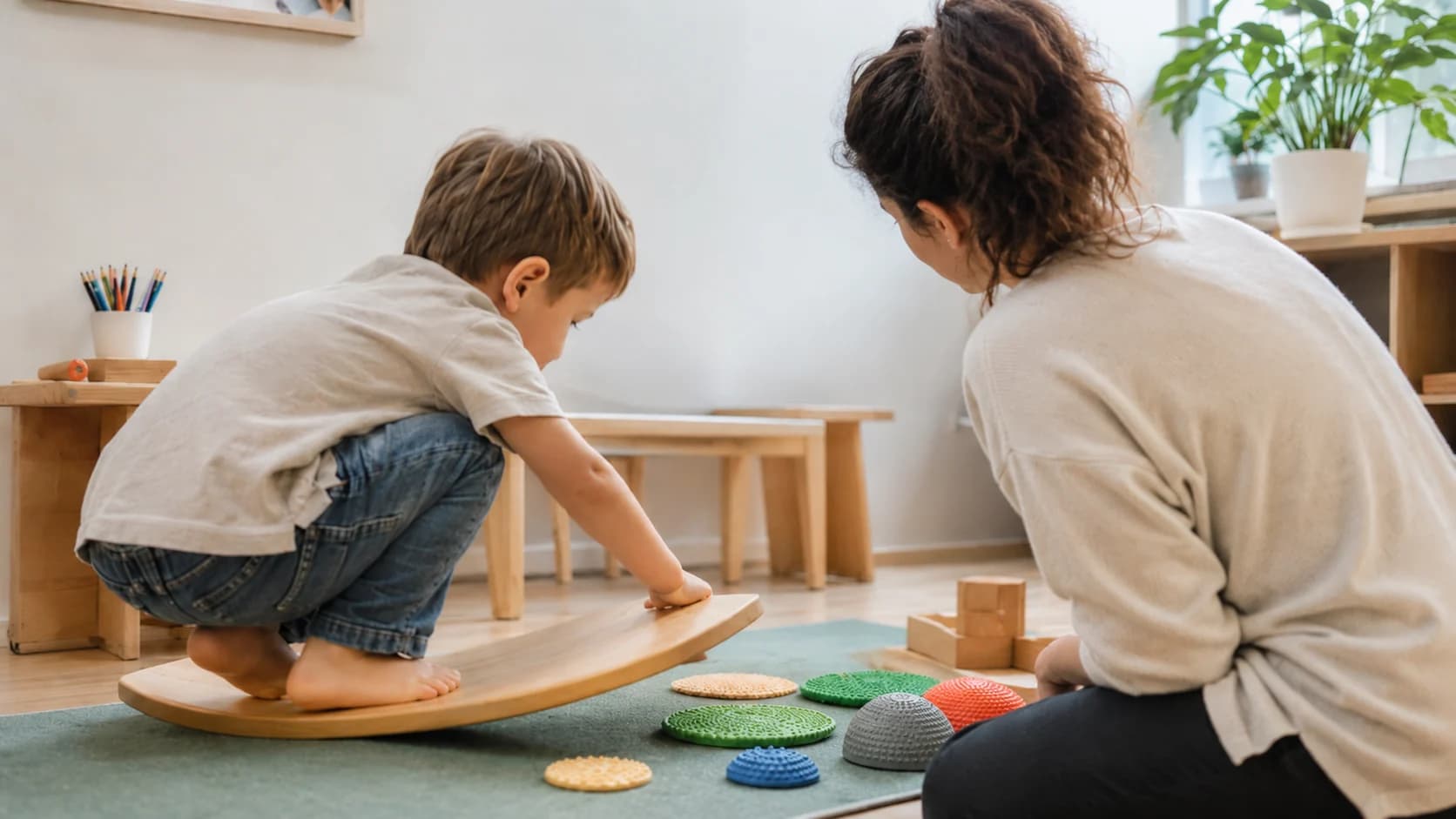
Sensory integration is the process by which the nervous system organizes information from the environment and from the body. When this processing is difficult, a child may react to touch, sound, movement, or food in a way that looks surprising or overwhelming. An SI assessment can help explain what stands behind those reactions and plan practical support.
What is sensory integration?
Sensory integration theory was developed by A. Jean Ayres. It describes how the brain receives and combines information from many sensory systems, including touch, proprioception, balance and movement, hearing, vision, taste, and smell.
When sensory processing works smoothly, the child can use the body, focus attention, play, learn, and communicate more comfortably. When it is difficult, the nervous system may react too strongly or too weakly to everyday sensations. Ordinary routines can then become unnecessarily demanding.
Sensory processing difficulties are not a standalone medical diagnosis in DSM-5 or ICD-11. They may accompany autism, ADHD, prematurity, delayed speech development, or appear as part of an individual sensory profile.
Which signs may suggest sensory difficulties?
The signs below are starting points for observation, not a diagnosis. A consultation is worth considering when several of them interfere with everyday life at home, preschool, or school.
- strong reactions to clothing labels, grooming, accidental touch, or walking barefoot on grass or sand,
- constant movement, intense physical contact, crashing into objects, or weak awareness of bumps and bruises,
- frequent falls, poor balance, difficulty climbing stairs, cycling, or joining movement games,
- covering ears in noisy places, avoiding bright or crowded spaces, or needing a long time to calm down after sensory overload,
- strong food selectivity connected with texture, smell, or consistency,
- pencil-grip, drawing, handwriting, or fine-motor difficulties,
- difficulty returning to calm after excitement or frustration.
For parents
How is sensory integration connected with speech development?
Speech and sensory regulation are connected, although not always in a direct way. A child who is busy managing noise, movement, touch, or body position may find it harder to focus on interaction or speech therapy tasks.
When sensory difficulties and speech delay occur together, therapy is usually clearer when both areas are considered. A speech therapist and an SI therapist can coordinate goals so that communication work happens in conditions the child can tolerate.
How does a sensory integration assessment work?
An SI assessment is usually carried out by a certified sensory integration therapist. It combines a parent interview, questionnaires, clinical observation, and, when age-appropriate, standardized tests. For the child it should feel like structured play rather than a school exam.
- Parent interview: pregnancy, birth, early development, daily routines, food, sleep, play, movement, and situations that raise concern.
- Sensory questionnaires: structured tools help organize parent and teacher observations.
- Clinical observation: the therapist watches how the child uses movement, touch, balance, posture, and planning in a sensory room.
- Standardized tests: from around 4 years of age, a therapist may use standardized tasks to assess praxis, balance, tactile processing, and spatial orientation.
Before the visit
How does SI therapy work?
Ayres Sensory Integration therapy is organized play in a specially equipped room. The therapist chooses activities that are challenging enough to support adaptation, but not so intense that the child becomes overwhelmed.
Recent systematic reviews in the American Journal of Occupational Therapy describe beneficial findings for ASI in children with autism, especially for individualized functional goals and participation. Research in other groups of children is still developing, so claims should stay cautious and goal-based.
SI therapy does not replace speech-language assessment, speech therapy, medical care, or other forms of support. It works best when it is part of a coordinated plan.
When is it worth consulting a specialist?
There is no single threshold that automatically means a child needs SI therapy. A consultation is useful when several sensory signs last for weeks or months, affect everyday functioning, or are noticed by more than one adult involved in the child's care.
SI support at StacjaMowa in Gdansk
At StacjaMowa, sensory integration support is part of a multidisciplinary view of the child. When needed, an SI therapist, speech therapist, neurologopedic therapist, and hand therapist can compare observations and agree on a practical order of work.
If you are unsure whether your child needs an SI assessment, a first consultation can help you name the observed difficulties, choose what to monitor, and decide whether specialist assessment is justified.
Key takeaways
- Sensory integration is the way the brain organizes information from the body and the environment.
- A single sign is not enough for diagnosis; the pattern and impact on daily functioning matter.
- SI assessment combines interview, observation, questionnaires, and age-appropriate standardized tools.
- The current evidence for ASI is strongest in autism-related functional goals; other areas require cautious interpretation.
- SI therapy should complement, not replace, speech therapy or medical care when those are needed.
Sources
- Polish Sensory Integration Society: information about sensory integration theory and therapy
- Polish sensory integration portal: diagnosis and standardized SI test materials
- Ayres Sensory Integration® With Children Ages 0 to 12: A Systematic Review. American Journal of Occupational Therapy (2025). PubMed: 40193295
- Occupational Therapy Interventions Using Ayres Sensory Integration® in Pediatric Practice: A Systematic Review. American Journal of Occupational Therapy (2025). PubMed: 41324442
- Supporting Clinical Identification of Children with Sensory Integration Challenges: A Decision Guide for Primary Care Providers. Brain Sciences, 15(11), 1184 (2025). mdpi.com/2076-3425/15/11/1184
Want to learn more about therapy options?
Learn more about this therapyFrequently asked questions
- From what age can sensory integration be assessed?
- A full assessment with standardized tests is usually possible from around 4 years of age. For younger children, an SI therapist can still use parent interview and clinical observation to plan early support.
- Are sensory processing difficulties a medical diagnosis?
- Sensory processing difficulties are not a standalone disorder in DSM-5 or ICD-11. They can accompany autism, ADHD, prematurity, speech delay, or appear as part of an individual sensory profile. An SI assessment describes that profile and helps plan support.
- How long does SI therapy take?
- The duration depends on the child, goals, sensory profile, and regularity of sessions. It is better to review progress through specific daily-life changes than through one fixed timeline.
- Can SI therapy help a child with delayed speech?
- SI therapy is not speech therapy and does not replace work on communication. It may support therapy when sensory regulation makes attention, participation, or oral-motor work difficult. Coordination between specialists keeps the plan clearer.
- Do I need a medical referral for SI assessment?
- In a private clinic, a referral is usually not required. It is still worth informing the pediatrician or child neurologist when the symptoms are intense or occur together with other developmental concerns.
- Can SI therapy and speech therapy run at the same time?
- Yes. When the SI therapist and speech therapist exchange observations, the child receives more coherent support. The exact order and frequency should follow the assessment findings.
- How do I know whether my child needs SI therapy?
- If several sensory difficulties last over time and clearly affect home, preschool, school, meals, play, or sleep, a consultation is reasonable. The goal is to understand the child’s profile and decide whether therapy is needed.