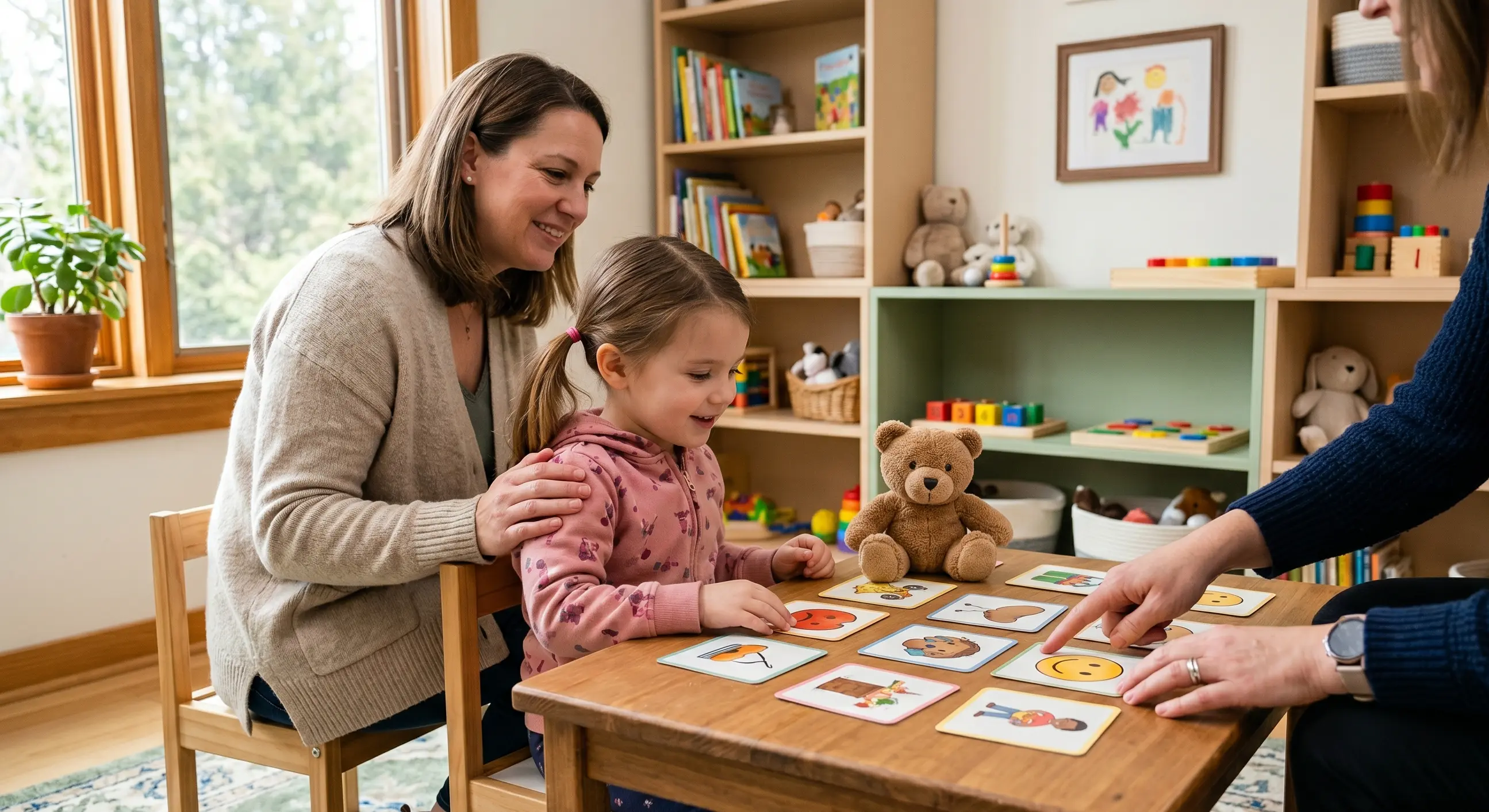
In some children, delayed speech development is not only about words, sentences, or pronunciation. Communication difficulties may coexist with sensory-processing challenges such as sound sensitivity, tactile defensiveness, overload in busy environments, or difficulty planning movement. This does not automatically mean a sensory integration disorder, but it can be an important clue that the diagnostic picture should be broader.
What delayed speech development means
Delayed speech development means that a child builds communication more slowly than expected for their age. They may start speaking later, use a small number of words, struggle to combine words into short messages, or understand language less efficiently in everyday situations.
A useful assessment is never limited to the question "does the child speak?". A speech therapist also looks at understanding, play, social contact, oral functions, movement, and the child's general developmental profile.
If you want to start with the core warning signs, read our related article on delayed speech development and when to see a pediatric speech therapist.
Why sensory processing matters for speech
Sensory integration describes how the nervous system receives, organizes, and uses information coming from the body and the environment. This includes not only hearing and vision, but also touch, balance, body awareness, movement planning, and regulation of arousal.
Speech development depends on more than vocabulary alone. A child also needs attention, readiness for interaction, body awareness, tolerance of touch and closeness, and the ability to imitate movement. When these areas are less stable, speech therapy may need a different pace and stronger regulation support.
This does not mean sensory difficulties are the only cause of delayed speech. It does mean that, in some children, sensory-motor challenges clearly affect how they participate, imitate, and tolerate therapeutic work.
When to think beyond speech alone
Signs that may suggest sensory difficulties
Not every child with delayed speech has sensory-processing challenges. Still, it is worth looking more closely when speech delay appears together with:
- very strong reactions to noise or sudden sounds,
- clear discomfort during face washing, tooth brushing, hair brushing, or skin care,
- a constant need for movement and deep pressure, or the opposite: strong avoidance of movement activities,
- frequent tripping, clumsiness, and poor motor planning,
- quick distractibility and difficulty finishing tasks,
- difficulty imitating gestures and speech exercises,
- marked tension during table work or during activities involving the face and mouth.
One sign alone is not enough for a conclusion. What matters is the full functional pattern and how strongly it affects daily routines and therapy.
How sensory difficulties can affect speech therapy
Children do not learn speech in isolation from the body, movement, and interaction. If regulation, attention, or motor planning are difficult, speech practice can become much more demanding.
In practice, this often means:
- the child tires quickly and loses readiness to cooperate,
- oral-motor activities are harder to tolerate,
- copying the position of the tongue, lips, or jaw after a model is more difficult,
- tension, shutdown, or overactivation replace steady focus on the task,
- more time is needed to enter an activity and stay engaged with it.
This does not mean that every speech difficulty is sensory in origin. It does mean that, for some children, supporting sensory-motor regulation improves comfort and readiness for language and articulation work.
What an assessment looks like
A useful assessment does not stop at speech alone. In practice, the best starting point is a speech or neurologopedic consultation combined with a detailed developmental interview and observation of how the child functions in real tasks.
That process may include:
- evaluation of language understanding and spontaneous communication,
- observation of articulation and oral functions,
- review of play, attention, and social interaction,
- closer observation of reactions to sensory input and movement organization when indicated,
- additional referrals if the overall developmental picture requires them.
When sensory challenges are clearly present, it may also be helpful to add a sensory integration consultation. This does not replace speech therapy. It helps explain what may be making participation and learning harder for the child.
On a separate page we describe assessment and therapy for delayed speech development.
How to combine speech therapy and SI support
Speech therapy and sensory integration support work on different, but often related, areas. One focuses on language, communication, and articulation. The other focuses on regulation, movement organization, and processing of sensory input.
In practice, a combined plan may include:
- support for regulation and readiness for tasks,
- work on posture, breathing, and movement organization,
- activities that strengthen imitation and coordination,
- parallel work on vocabulary, language comprehension, communication, and speech clarity,
- simple home guidance adjusted to the child's profile.
Consistency matters most. When parents receive a clear plan and specialists work toward the same goals, it becomes easier to monitor progress and adjust therapy in a meaningful way.
More is not always better
What you can do at home
Home does not need to turn into a second therapy room. For most children, short and calm routines built into everyday life work better than long exercise blocks.
- movement play with rolling, changing positions, and whole-body work,
- simple heavy-work activities such as pushing, pulling, or carrying light objects,
- tactile play matched to the child's tolerance,
- pairing movement with language: naming, choices, simple instructions, and syllable play,
- short calming routines before tasks that require more focus.
If you also notice fine-motor difficulties during table tasks, read our article on hand therapy and speech development.
If your child needs extra tools to express needs and choices, this article on introducing AAC in practice may also be useful.
When to book a consultation
It is worth seeking consultation when delayed speech appears together with strong sensory reactions, high distractibility, poor tolerance of face and mouth work, motor clumsiness, or frequent overload in daily situations.
For many families, the safest first step is a calm speech or neurologopedic consultation. From there, it becomes easier to decide whether the child needs speech support alone or a broader diagnostic plan.
Key takeaways
- Delayed speech does not always appear in isolation from other developmental challenges.
- In some children, sensory-processing difficulties affect attention, behavior, and readiness for therapy.
- A good assessment should include not only speech, but also the wider functional picture.
- Speech therapy and SI support do not compete with each other. In a well-matched plan, they can complement one another.
Want to learn more about therapy options?
Learn more about this therapyFrequently asked questions
- Does every child with delayed speech have sensory difficulties?
- No. In some children, delayed speech mainly concerns language. In others, sensory-processing challenges also affect attention, behavior, and participation in therapy.
- When is it worth seeing both a speech therapist and an SI therapist?
- It is worth considering when delayed speech comes together with strong sensory reactions, high activity or withdrawal, difficulty imitating, motor clumsiness, or marked tension in everyday routines. That combination often calls for a broader assessment.
- Can sensory integration therapy replace speech therapy?
- No. Sensory integration therapy does not replace work on language, communication, and articulation. It may support regulation, movement, and readiness for learning, which can make speech therapy more accessible for some children.
- Are sensory difficulties always the cause of delayed speech?
- No. They may coexist with delayed speech and influence how therapy goes, but the relationship is not automatically causal. Each child needs an individual clinical assessment.
- Can parents work with the child at home?
- Yes, but the plan should stay simple and guided by a specialist. Input that is too intense or poorly matched may overload the child instead of helping.
- Where should we start if we suspect delayed speech and sensory challenges?
- The safest first step is a speech or neurologopedic consultation together with a clear description of daily difficulties. If needed, the therapist can then recommend extending the diagnostic process to the sensory area.