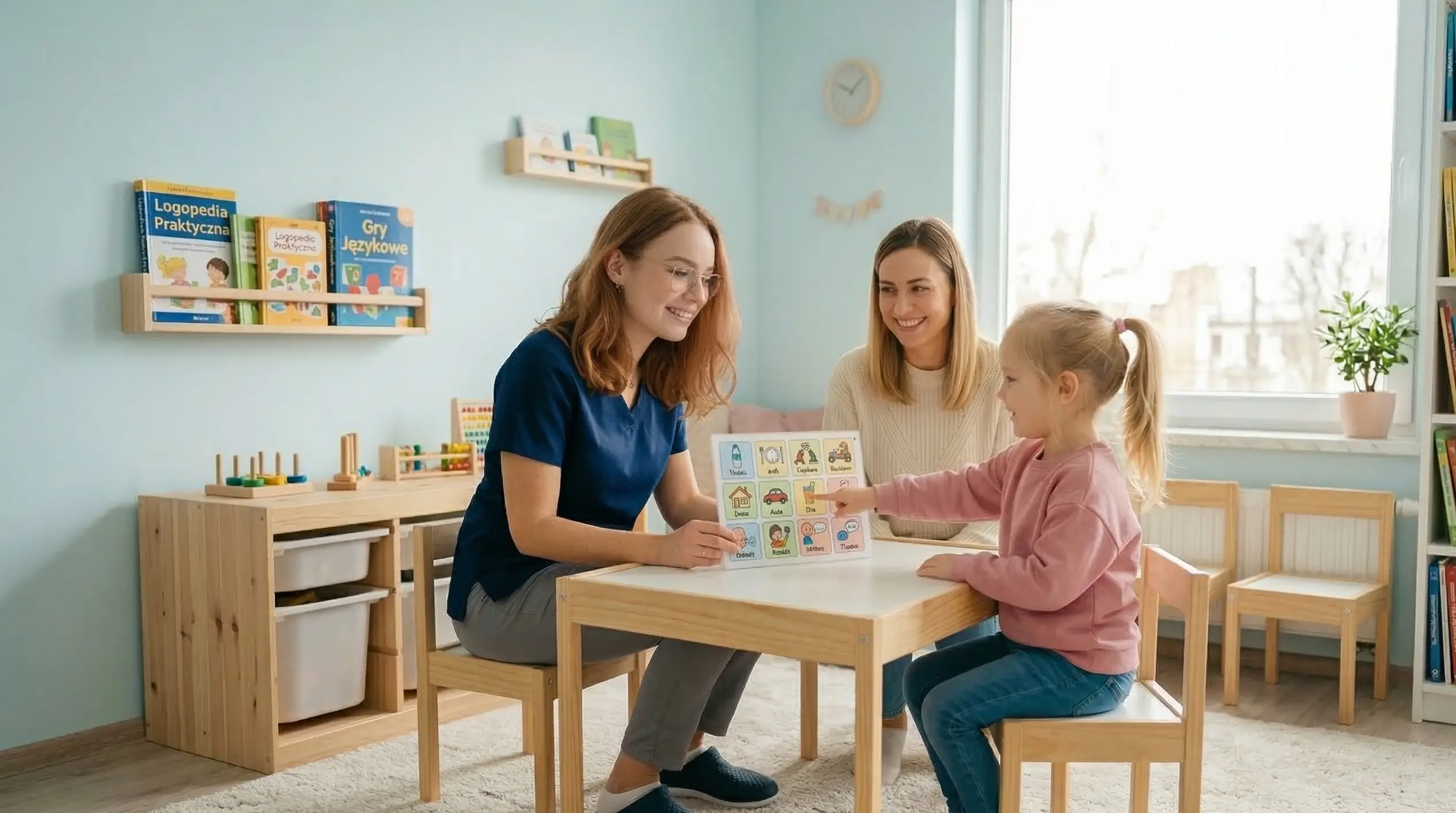
Your child says a few words, but they are hard to understand? This is often the moment when parents hear about AAC and wonder whether augmentative communication might hold speech development back. In practice, well-chosen AAC does not replace speech - it helps the child communicate effectively here and now, while also being able to support language development.
What is AAC for a child who speaks a little?
AAC (augmentative and alternative communication) covers every way of communicating other than speech alone: gestures, picture boards, communication books and apps with speech synthesis. For a child who speaks partially, AAC is usually augmentative in nature - it supplements what is said when words are not enough.
In practice, a child may say a single word and point to a symbol at the same time to make the message clearer. This helps the people around them understand the intention faster, and the child experiences greater agency in everyday situations.
If you want to see the basics of introducing a system step by step, also read our article on how to introduce augmentative and alternative communication (AAC).
Does AAC hold back speech development? What research and guidance say
This is one of the most common parental worries. Current research reviews and clinical recommendations indicate that well-run AAC does not hold back speech development. Many children show improvement in functional communication, more communication initiations, and growth in vocabulary.
This happens partly because AAC reduces frustration and increases the number of opportunities to practise language in natural situations. A child attempts contact more often, because they have a tool that works even while articulation is still unclear.
What matters is that AAC is introduced alongside speech therapy and neurologopedic therapy, not instead of it. At StacjaMowa we treat AAC as part of a broader plan for communication development.
The most important rule
When is it worth considering AAC for a child who speaks a little?
The decision should not be based on age alone, but on how the child communicates day to day. An AAC consultation is usually a good step when:
- the child has a small vocabulary and is clearly frustrated by not being able to say what they are thinking,
- speech is unclear enough that even close family find the message hard to understand,
- additional developmental difficulties are present, for example on the autism spectrum or with complex language disorders,
- speech development has stalled despite therapy, but the child actively seeks contact through gesture, pointing, and leading an adult.
In the context of delayed speech development, it is also worth reading our article on delayed speech development: when to see a children's speech therapist.
What does the AAC implementation process look like at StacjaMowa?
Introducing AAC is a process, not a one-off choice of app. In practice it involves several stages tailored to the child's abilities and the family's daily life.
- Communication assessment: the neurologopedist evaluates the child's current ways of communicating, their understanding of speech, motor profile, and the needs of their environment.
- Choosing the AAC form: we choose a solution that is realistic to use at home, at nursery, and during therapy.
- Starter vocabulary: we start with words the child genuinely needs, not with an overly elaborate system.
- Modelling by adults: the parent and therapist show symbols alongside speech, so the child sees the system used in practice.
- Regular plan updates: as the child progresses, we adjust the vocabulary and communication goals.
A tip for getting started
How does AAC connect with speech therapy and neurologopedic therapy?
AAC does not operate separately from speech therapy. At StacjaMowa we combine them into one plan: the child gets the ability to communicate effectively, while also working on understanding, vocabulary, sentence building and speech quality.
This model reduces pressure for immediate, perfect pronunciation and allows the focus to stay on the overarching goal: effective communication. This is exactly why AAC works well alongside both classic speech therapy and a more complex neurologopedic plan.
If your child needs support specifically in the AAC area, also see our augmentative and alternative communication (AAC) service in Gdańsk page.
How to support AAC at home? Practical tips for parents
The biggest progress usually appears when AAC becomes part of everyday activities. There is no need to create separate, long sessions.
- the AAC tool should always be within reach, not put away "until exercise time",
- model communication calmly, without forcing immediate repetition,
- respond to every attempt at contact, even if the message is incomplete,
- practise in situations the child enjoys and that naturally motivate communication.
For families of non-speaking children, our article on when a child does not yet speak: how AAC works can also help, describing the basics in a simple, step-by-step model.
Key takeaways
- Well-chosen AAC does not hold back speech development and can increase the child's readiness to communicate.
- AAC is also worth considering for children who speak partially but remain hard for others to understand.
- The best results come from combining AAC with speech therapy and neurologopedic therapy alongside regular family support.
- Small, consistent steps at home usually work better than occasional, intense attempts.
Sources and literature
The materials below are educational in nature and support decision-making in cooperation with the treating therapist.
- HealthyChildren (AAP): Beyond Spoken Words - AAC for Kids
- Leonet et al. (2022): Systematic review of AAC interventions in children 0-6
- Costantino, Bonati (2014): Scoping review of AAC interventions
- Brady et al. (2013): AAC support in preschool and language growth
- ASHA Practice Portal: Augmentative and Alternative Communication
Want to learn more about therapy options?
Learn more about this therapyFrequently asked questions
- Will my child stop speaking after AAC is introduced?
- Current research does not support that risk. Well-run AAC usually does not hold back speech, and often increases the number of opportunities to learn words while lowering communication frustration. What matters is running speech therapy alongside it and having adults regularly model speech.
- Is AAC only for children who do not speak at all?
- No. AAC is also for children who speak partially but are hard to understand, have a small vocabulary, or cannot build sentences fluently. In these situations, an augmentative system helps communicate needs now, without waiting for full speech development.
- At what age can AAC be started?
- AAC can be introduced very early, including in young children, if communication is clearly difficult. The decision is based on real functional needs rather than a fixed age limit. The earlier a child gets an effective communication tool, the easier it is to build further language skills.
- Do we need to buy an advanced tablet right away?
- Not always. For some children, low-tech solutions such as picture boards, a communication book, or a simple communicator are a good start. The form of AAC should be chosen individually and be realistic for the family to use every day.
- How long does introducing AAC take?
- It is a process that depends on the child’s profile, how regularly it is used, and support from those around them. There is no single, universal timeframe after which results "should" appear. What matters is gradually expanding the system and continuously adjusting therapy goals.
- What if after a few months the child still speaks very little?
- Even with slower speech growth, AAC can bring major functional benefits: less frustration, better relationships, and greater communication independence. That is still a valuable therapy outcome. In that case, it is worth updating the work plan together with the therapist rather than giving up the tool.