The first visit to a speech therapist is a completely new situation for many children on the autism spectrum: a different place, unfamiliar people, unknown rules. Good preparation - for both the child and the parent - reduces stress, makes assessment easier, and helps make the best use of time with the therapist. In this article we show you step by step what the first visit at StacjaMowa looks like and what you can do to make it as predictable and safe as possible for both of you.
Autism and a new environment - what challenges does the child face?
A child on the autism spectrum often reacts intensely to sensory input: light, sounds, smells, touch, and changes in routine. A new clinic environment, unfamiliar chairs, scents, and faces can cause tension, even when the child appears calm on the surface.
Communication itself may also be challenging - some children speak very little or not at all, others struggle to understand questions, interpret language literally, or need more time to respond. That is why it matters so much that the speech therapist has space for calm observation and a conversation with the parent, while the child feels confident about what to expect and knows where to withdraw if needed.
What does the first speech therapy visit at StacjaMowa look like?
At StacjaMowa, the first visit is both diagnostic and planning-oriented: the speech therapist or neurologopedic specialist gathers a detailed history, observes the child during play and everyday communication, and proposes an initial support plan. The conversation covers not only speech, but also behaviour, sensory responses, difficulties at nursery or school, previous diagnoses, and prior therapies - all to understand your family's situation as fully as possible.
During the visit, the specialist explains what the next steps might look like: whether further assessment is needed (such as neuropsychological or psychiatric), when to consider introducing augmentative and alternative communication (AAC), and how frequently to schedule therapy sessions. Many of the organisational elements are similar to those described in our article on delayed speech development and the first speech therapy appointment.
What to prepare before the visit - documents, notes, recordings
Good preparation on the parent's part helps the therapist quickly build a full picture of the child's functioning. It is worth bringing: medical documentation (discharge summaries, psychological reports, hearing test results, autism diagnoses, official assessments), as well as any nursery or school reports if available.
Short notes from home are also very helpful: examples of behaviours that concern you (with dates), situations in which the child communicates most willingly, and a list of questions you don't want to forget in the stress of the moment. Specialists increasingly recommend short video recordings of typical everyday situations (such as play, a meal, or going to the bathroom) - these show the child's behaviour in their natural environment, where they are often calmer than in a clinic.
Important
How to prepare a child on the spectrum for the visit, step by step
Preparing a child with autism for a speech therapy appointment is like preparing for a journey: simple, concrete information, a repeatable plan, and the chance to “rehearse” the situation in advance all make a real difference. For many children, short daily conversations about what will happen work well: when you are going, what the clinic looks like, who will be there, and what the speech therapist will do.
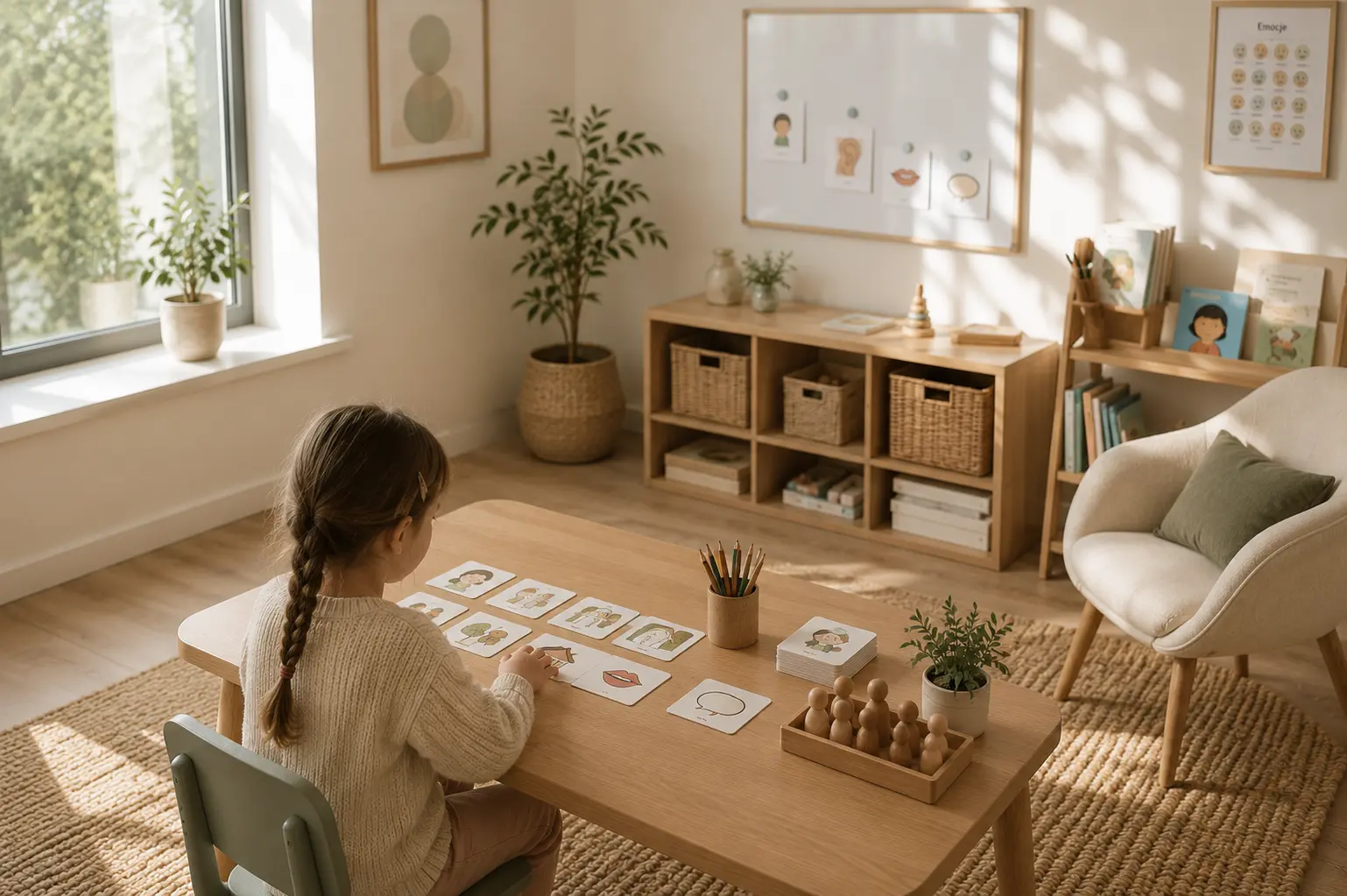
Use clear, literal language, avoid jokes and ambiguity, and go through the visit step by step - for example: “First we will go to the waiting room, then the lady will call us in, we will sit at the table, you can play with blocks, and I will tell her about you.” Simple picture stories or comic strips showing the stages of the visit can also help - you can draw them yourself or use ready-made educational materials.
If your child already uses AAC (such as a communication book, picture board, or app) - it is worth including vocabulary related to the visit (e.g. “speech therapist”, “clinic”, “assessment”, “end of visit”) and allowing the child to ask questions through their communication system. The speech therapists and neurologopedic specialists at StacjaMowa work with AAC-using children every day, so bringing a device or communication book is very much welcome.
How to support sensory comfort on the day of the visit
For many children on the autism spectrum, reducing the number of sensory inputs and ensuring predictability are key. On the day of the visit, it is worth choosing comfortable, non-scratchy clothing, bringing a favourite hoodie or blanket, and making sure the child is neither very hungry nor very tired - to the extent that this is possible.
Where possible, booking an appointment at the very start or end of the day can help limit crowding in the waiting area and avoid bright lights and loud noises. Preparing a “support kit” with a favourite toy, a fidget, a book, or noise-cancelling headphones can make a real difference. At StacjaMowa, staff aim to adapt the visit flexibly to the child's needs - you can let them know via the contact form or by phone that your child is on the spectrum and describe what helps most.
Tip for parents
What happens in the clinic room - step by step
At the start of the visit, the therapist usually spends the first part talking with the parent while the child explores the room, plays with selected toys, or simply gets used to the space. For children on the spectrum, the pace of approaching the child is adjusted to their responses - sometimes the first visit is primarily about observation and building a sense of safety, with more formal assessment tasks introduced gradually.
During the assessment, the therapist evaluates: communication style (speech, gesture, pointing, AAC), responses to name and instructions, comprehension, play behaviour, eye contact, and orofacial functions (breathing, chewing, swallowing). Where needed, the therapist may suggest a consultation with a neurologopedic specialist in Gdańsk or a sensory integration therapist - parents receive this information calmly and concretely, with a clear explanation of the next steps.
If the child already uses AAC, or if the therapist identifies it as needed, gradual introduction of augmentative communication may be proposed alongside speech work. ASHA guidelines confirm that early introduction of AAC does not inhibit speech development - it can in fact support language growth and reduce the frustration that comes with communication difficulties. You can read more in our article on AAC for a child who speaks a little.
How to talk about the visit - language that supports, not frightens
The way you talk with your child about the visit matters a great deal. Instead of using fear-based framing (“The lady will tell me if you've been naughty”), it is better to focus on concrete support: “The speech therapist will help us find ways to say things so that other people understand you better.”
When working with children with ASD, it is particularly important to avoid irony, jokes, and metaphors that may be taken literally. Short, clear sentences describing what will happen work much better: “We will go to the clinic. The lady will ask me about you. You can play with the blocks or show her what you like doing. Then we will go home.”
If your child has already been to other specialists, you can refer to those experiences while pointing out the differences: “With the doctor there was a blood test, but here the speech therapist plays with children and works out the best way to communicate with them.”
After the visit - how to continue support at home and at school
After the first visit, the therapist typically presents an initial plan: what to try at home, how often to consider sessions, and when to return for a follow-up or extended assessment. Parents can expect practical guidance on everyday communication - not just “a set of exercises” - which often means small changes in routine, the way questions are asked, or how to respond to the child's behaviour.
For children on the autism spectrum, collaboration with nursery or school is particularly important: sharing communication strategies with teachers, agreeing on simple approaches for more difficult situations, and - where possible - using the same symbols, gestures, or AAC tools consistently. In some cases, the neurologopedic specialist may also suggest sensory integration therapy or hand therapy, which support sensory regulation and readiness to learn.
If delayed speech development comes up during the assessment, you can refer to our guide on delayed speech development and warning signs, which describes each step in detail. When the specialist recommends AAC, it is also worth reading about AAC for a child who speaks a little, to understand how augmentative communication can work alongside developing speech.
Key takeaways
- A child on the autism spectrum may react strongly to change and sensory input, so the first speech therapy visit requires calm, planned preparation.
- Preparation includes both documents and notes for the parent, and gradually familiarising the child with the idea of the visit through conversations, pictures, and “playing clinic”.
- At StacjaMowa, the first visit is both diagnostic and planning-oriented, with the pace of work adapted to the child's abilities and the family's needs.
- Early introduction of AAC can help a child with autism to express needs and emotions without inhibiting speech development.
- After the visit, the key is collaboration between parent, child, therapist, and nursery or school, based on simple, repeatable strategies.
Sources and references
- MP.pl: recommendations for organising medical visits for children with autism spectrum disorder
- Synapsis Foundation: preparing a young child on the autism spectrum for a clinic or hospital visit
- Błeszyński J.J. (2022). Organisation of speech therapy for children with autism. Logopedia Silesiana, 11(1) - University of Silesia (OA)
- Syta A. (2018). Speech and communication development in a child with autism spectrum disorder. Logopedia Silesiana, 7 - University of Silesia (OA)
- ASHA Practice Portal: Autism Spectrum Disorder - role of the SLP in assessment and treatment
- Forum Logopedyczne: speech therapy for a child on the autism spectrum
Want to learn more about therapy options?
Learn more about this therapyFrequently asked questions
- Does my child need a formal autism diagnosis before the first speech therapy visit?
- No - a confirmed diagnosis is not a prerequisite for starting work with a speech therapist. An early consultation helps clarify the situation, and the therapist can suggest what further assessments are worth considering while supporting communication right now, even if the autism diagnostic process is still under way.
- Does a visit make sense if my child does not speak or speaks very little?
- Absolutely. Speech therapists work not only on verbal speech but above all on communication - including non-verbal and augmentative approaches (AAC). Well-chosen AAC tools can support language development, and the child gains a way to express needs and emotions regardless of where they are in their verbal speech journey.
- Does my child have to cooperate during the first visit? I am worried they will refuse everything.
- The therapist does not expect perfect cooperation, especially at a first meeting with a child on the autism spectrum. How the child behaves in a new situation is already valuable information. Sometimes the first visit is primarily observation and building a sense of safety, with assessment tasks introduced gradually over time.
- Can I stay in the room with my child throughout the visit?
- In most cases parental presence is actively encouraged, particularly with younger children and children on the spectrum. The parent is an important part of the therapeutic process - observations, findings, and home strategies are discussed with the parent directly.
- What if my child struggles badly with new places - is there a way to start remotely?
- It is worth starting with a phone call or a contact form message to describe your concerns and ask about possible options. Sometimes the right first step is a shorter 'familiarisation' visit or an online consultation with the parent, after which a safe in-clinic meeting is easier to plan.
- Will the therapist force my child to do exercises if they refuse?
- Speech therapy for a child with autism is built on relationship, trust, and a sense of safety - never on coercion. The therapist chooses activities that are as engaging and predictable as possible, and introduces new tasks at a pace that matches the child's current abilities.